
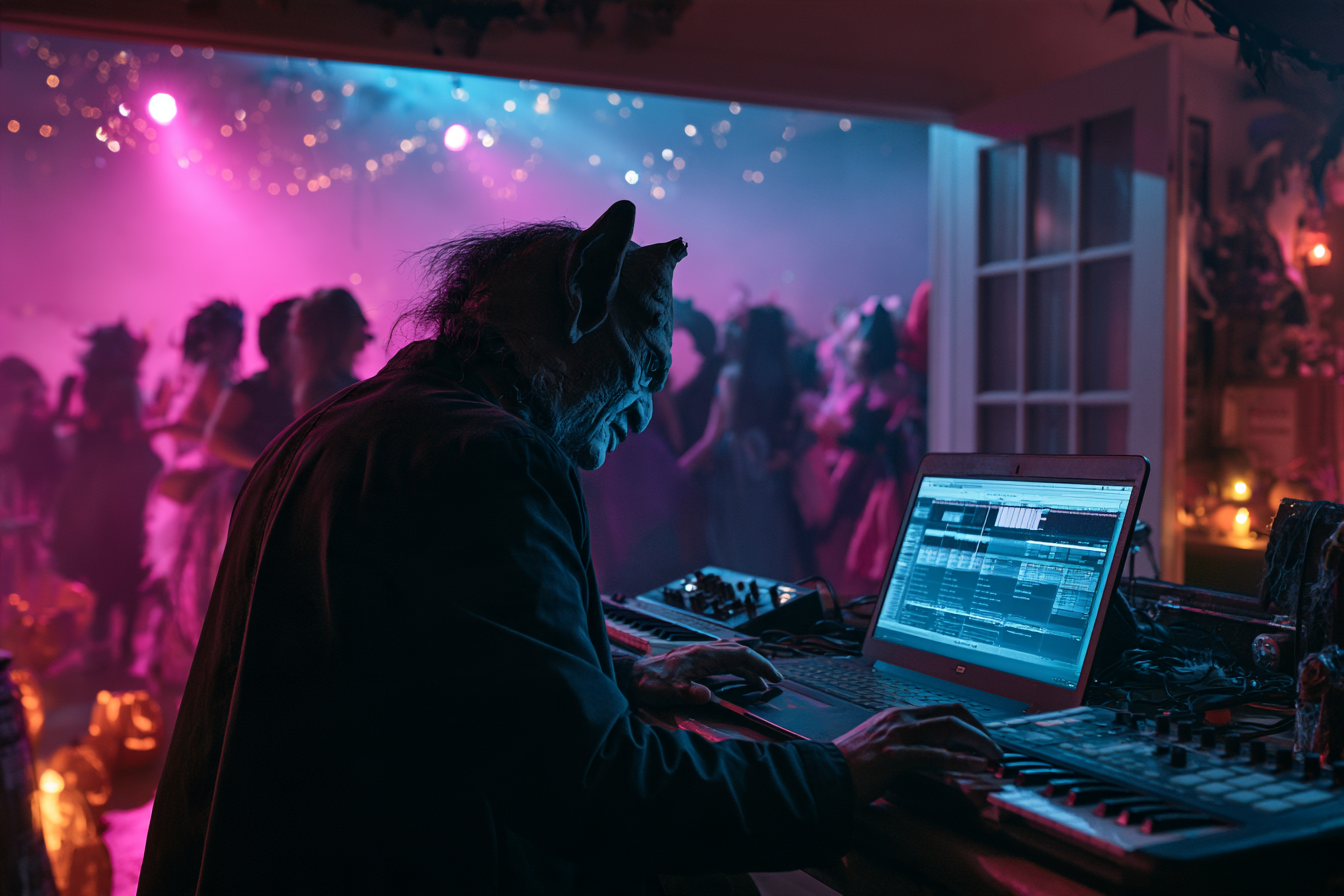
Halloween has always embraced exactly the things about music that people now love to hate. The best example of this is the perpetual Halloween party crowd-pleaser, "Monster Mash." It has many of the same characteristics that AI music is criticized for today.
This includes synthetic vocals, a fake band, using ideas from other trends of the day, and being written and recorded in less than an hour (though this is actually not true at all for most serious AI music!). Most record labels passed on it, and many outlets refused to play it. Yet it went to No. 1 on the Billboard Hot 100 for two weeks in October 1962, has come back to the charts in six different years since, and still averages about $1M in revenue per year today.
I regularly hear that "AI music" (I prefer AI-enabled artists and just plain music) is a fast, fake, derivative novelty made by people who can't sing… then every October I notice that this is also an exact description of some of the best-loved Halloween music in America and beyond.
I love Halloween, and Halloween music, and I also love to make music with a variety of AI tools for an animated children's character — Ellis Mo — based on my five-year-old son, who is also my collaborator.
As with most five-year-olds, he is obsessed with Halloween. Our "spooky season" starts in August, so at this point we've been planning his costume, visiting the Halloween stores, decorating, and listening to Halloween music for several months! This year we even made a Halloween album: 10 doo-wop-inspired songs ("boo wop!") averaging 16 facts per song about the holiday's history and all of the monsters he loves.
Halloween was made for AI music, because Halloween music has always been made the way AI music is made now.
The Graveyard Smash Was Basically a Prompt
Bobby Pickett was an aspiring actor who fronted a cover band called The Cordials at night. One night he dropped a Boris Karloff impression into the middle of a cover of "Little Darlin'" (of which the famous version from American Graffiti was also a cover), and the crowd loved it. His bandmate Lenny Capizzi told him to do more with the voice. They wrote a song around it in about 30 minutes, then recorded it in less time. It was meant to cash in on the Mashed Potato, the dance craze of the moment. Pickett voiced Karloff as the mad scientist, Bela Lugosi as Dracula, and Peter Lorre as Igor.
The session was at Gold Star Studios in Los Angeles, and the sound design came from the kitchen and the toolbox. The bubbling cauldron is a straw in a glass of water. The coffin lid is a rusty nail being pulled out of a board. The chains are indeed chains, dropped on a tile floor. The band was billed as the Crypt-Kickers, but nobody can say for certain who actually played on the record.
Now take the date off and read it back as a 2026 release. A non-singer with a concept. A celebrity voice he did not own. A style reference to the hottest genre of the year. A virtual band. Half an hour of writing and less than that in the studio. The comment section writes itself.
At least four labels rejected the song. The BBC banned the record as "too morbid." Then a radio station played it, listeners got hold of it, and none of that mattered, because it skyrocketed to No. 1 on the Hot 100 within two months of its August 1962 release, staying there for two weeks.
Then he took it on television to "perform." In October 1964, Pickett performed "Monster Mash" on American Bandstand. Watch it. There is no band on that stage. The Crypt-Kickers or anyone playing an instrument are nowhere to be seen. It is one man in a suit making faces and lip-syncing while a record plays, because just about every Bandstand performance from 1952 to 1989 was lip-synced. Dick Clark said so himself and did not think it mattered. A solo performer with no band, miming to a pre-made track in front of a cheering crowd, was the format of a national TV institution for 37 years.
This is notably less creative than many of the AI-native artist performances today. DEATHPIXIE played Red Rocks as a 40-foot avatar with sword dancers and Skylar Grey singing live, and Chaisen Hale's Los Angeles show put a human performer, a children's choir, and a live band on stage.
"Monster Mash" never went away. The song came back to the charts in 1970, 1973, 2008, 2021, 2022, and 2023 and has passed 500 million streams. In 2025 Billboard ranked it the biggest Halloween song of all time, ahead of "Thriller." Miramax is turning it into an animated film. Pickett told People in 1996 that when he heard the song, he heard a cash register ringing.
"Monster Mash" Is the Rule, Not the Exception
The classic Halloween songs started as novelties, rush jobs, and accidents, and then got covered over and over by "real" musicians. The Beach Boys, the Misfits, Alice Cooper, and The Wiggles have all recorded "Monster Mash." The same will most likely happen with AI music, and it has already started: Hugel's "Movin' to the Sun" began as an AI-generated track by Imael Angel, was rebuilt in the studio with Ultra Naté on vocals, and went to No. 2 in the UK.
A few other notable examples:
A Man with a Machine and Fake Musicians in Three Days for the "Halloween" Theme (1978)
John Carpenter could not afford a composer for his upcoming Halloween movie, an independent film that the major studios had turned down and that was made for about $320,000 in roughly four weeks. He had three days, a piano, and a tube synthesizer. He says the main theme took about an hour and that the rhythm came from a 5/4 exercise his father taught him on the bongos. The score was credited to the Bowling Green Philharmonic Orchestra, which was not real: Carpenter made the name up. A filmmaker with a machine, a deadline, and an invented credit wrote the cue that still means October.
A Reference Track and an Artist as Inspiration for "Ghostbusters" (1984)
The filmmakers cut the movie to Huey Lewis's "I Want a New Drug" as a placeholder. Lewis turned down the theme job, so they handed Ray Parker Jr. footage with the Lewis song still playing under it and gave him a few days. The result spent three weeks at No. 1 and got an Oscar nomination. Lewis sued, and the case settled out of court in 1985. Today that would be called generating from a reference track, and the major AI music generators block it by default. Type "in the style of Huey Lewis" into Suno and the prompt gets rejected. In 1984, it got an Oscar nomination.
A Fictional Character for "I Put a Spell on You" (1956)
Jay Hawkins wanted to be an opera singer and wrote this one as a refined love ballad. His first straight recording went nowhere. For the second, producer Arnold Maxin decided the band sounded too polished, got everyone drunk, and called the session a party. Hawkins shrieked and growled through the take, said afterward that he did not remember it, and had to relearn his own song from the single. Radio stations banned it. It sold more than a million copies without ever charting. Then DJ Alan Freed paid him $300 to climb out of a coffin on stage, launching a persona that followed him for the rest of his life. He spent decades filed under novelty. Then Nina Simone's 1965 cover became the version that earned the song its respect. The original performance was not even remembered by the artist, the character was invented by a promoter, and the acclaim went to a later performer.
Synthetic Vocals for "The Purple People Eater" (1958)
Sheb Wooley recorded a normal voice and a normal sax solo, then sped up the tape to get the alien. He took the trick from David Seville's "Witch Doctor," which had gone to No. 1 that April. The technology gimmick was the hook. Nobody on earth sounds like that alien: the voice was manufactured by a machine after the performance was over, which is the complaint about every AI vocal today. It spent six weeks at No. 1.
A Ghost Singer's Son and Strangers with Software for "Spooky, Scary Skeletons" (1996)
Andrew Gold, the author of the Golden Girls theme song among other things, wrote this for a kids' novelty album because he thought Halloween did not have enough songs. He had the right pedigree for a song other people would finish. His mother was Marni Nixon, Hollywood's most famous ghost singer, the uncredited voice coming out of Audrey Hepburn in My Fair Lady and Natalie Wood in West Side Story. The song sat for 14 years.
Then someone on the internet uploaded it to YouTube in 2010 and paired it with a 1929 Disney skeleton cartoon, then someone remixed it in 2013, and TikTok turned the remix into a dance in 2019. Gold died in 2011, before the remix and TikTok versions existed. It now has more than 100 million YouTube views, the song has been used in more than 5 million TikTok videos, and it is certified Platinum. The internet's Halloween anthem is a children's novelty track by the son of a ghost singer, finished by strangers with software after he was gone.
That's six records built on a voice impression, a studio accident, a tape trick, a synth score on a three-day deadline, a placeholder track, and a remix. Novelty, speed, borrowed voices, new machines, and a made-up name on the label are the tradition.
Why This Holiday Is a Good Starting Point for AI Music
Halloween is the one night when pretending to be something else is the entire point. Nobody at the door asks the seven-year-old in the cape whether he is really a vampire. The costume is the craft. I think Halloween is a great starting point for AI-native artists to make music that hits the mainstream in a serious way.
AI music spends the other 364 days being interrogated about the costume. Who is really singing. Who is really behind the artist. Whether the band exists. Zinstrel ran a whole issue on the secret identities of AI artists on Sept. 30. On October 31, the answer to all of it is a mask, and everybody claps.
It is also a holiday with almost no songbook. Christmas has centuries of carols. Halloween has one playlist: Billboard's all-time Halloween ranking is just 25 songs long, and the winner is from 1962. And Americans will spend $13.5 billion on Halloween this year, 74% plan to celebrate in a way that likely includes listening to seasonal music, and 47% told the National Retail Federation they are using AI tools to shop for it. The costume got AI before the playlist did.
The AI-enabled human artists with deals and chart positions have left this lane almost empty. Xania Monet signed with Hallwood after a $3 million offer and makes R&B. Breaking Rust topped Billboard's Country Digital Song Sales chart with "Walk My Walk." The Velvet Sundown passed a million monthly Spotify listeners with 1960s-style rock. TaTa Taktumi signed to Pacific Music Group in March. There is a person behind every one of those names. I went looking for a Halloween song from any of them and found none.
The one signed act that has an opportunity to own October is DEATHPIXIE, the virtual artist built by a team of human songwriters, producers, and animators on deadmau5's mau5trap label. Her debut EP ASYLUM came out on Oct. 31, 2025, her catalog includes "NOSFERATU" and "HELL GIRL," and she made her live debut a week later at deadmau5's Red Rocks shows. Everyone else is playing it straight on the one holiday that rewards a costume.
I have a theory about why this holiday keeps producing records like these. I LOVE Halloween. I also do not want to think about it in February. Halloween is a season, and nobody wants to spend a whole year in a studio perfecting a werewolf song. A Halloween record that took 12 months to make is a cry for help.
The classics understood this. Pickett took half an hour. Carpenter took three days. Parker got a few days. Human artists who are AI-enabled can work the way the canon always worked: have the idea in September, make the record in October, and be done by the time the candy runs out.
Then There Are the Kids
Kids are obsessed with Halloween, and mine is Exhibit A. He's in good company: children's costumes alone are a $1.5 billion line this year. Children's Halloween parties are often hurting for kid-friendly, not-too-scary Halloween songs. My son is too young to care who made the song or how; he just knows if he likes it and wants to dance to it. I want to make sure it is appropriate for him and ideally has some fun facts in it!
Kids are also the one audience that has no problem with AI music. Teenagers are the only age group that feels net positive when they learn a song was made with AI. Among 9- to 12-year-olds, 81% already use AI, and three-quarters of the kids who use it have made something with it. I have seen kids I know go looking for AI songs and videos on YouTube on purpose.
YouTube has noticed. When The New York Times tested what the platform recommends to preschoolers, more than 40% of the videos in one session appeared to be AI-generated, and most of it was junk made by people who do not care what a four-year-old learns.
That is the opportunity. The demand is real, the supply is bad, and Halloween is the easiest place to fix it. Kids want new monster songs every October, the classics are 60 years old, and nobody has to explain to a child why a song about a vampire is fun. Human artists who are AI-enabled can make great Halloween music for kids in weeks, and the kids will not ask how it was made. They will ask to hear it again.
The Playlist: Halloween Was Made for AI Music… Send Me Yours
This is a starting playlist, and a call for more. Halloween needs new songs, so here are the AI-enabled ones I have found so far, which shamelessly include several of my own. But I would like to add more! Please send me your best Halloween songs that use AI in the production process in some way! (hybrid or fully AI are both good).
Made a Halloween song with AI? Send it to hai@ellismo.com and I'll add it to the playlist.