

I discovered the music of Oakwood the Stranger this year, and it’s one of my favorite finds of 2026. I’m reviewing the two albums together because each makes more sense next to the other. Panic Garden is more my speed, but I wouldn’t skip 7271.
Oakwood the Stranger put out two albums in 2026, Panic Garden and 7271, a few months apart. They sound like the same person living through two entirely different realities. Thirteen tracks, just over an hour, and listening straight through is like watching an explosion in slow motion. It starts with subtle scratchings, the sonic equivalent of stray curls of excelsior at the bottom of an emptied wooden shipping crate. Sixty-odd minutes later you’re standing in the wreckage of distorted guitars and rhythmic detonations, with a final scream held for sixteen beats.
Oakwood’s vocabulary is easy to recognize and hard to categorize. Guitars and strings do most of the work, with results that are experimental and expressive at the same time. Shoegaze, progressive metal, chamber music, grunge, and noise rock all turn up, and none of them behave the way you’d expect. They’re compositional materials, points of paint on a much larger canvas.
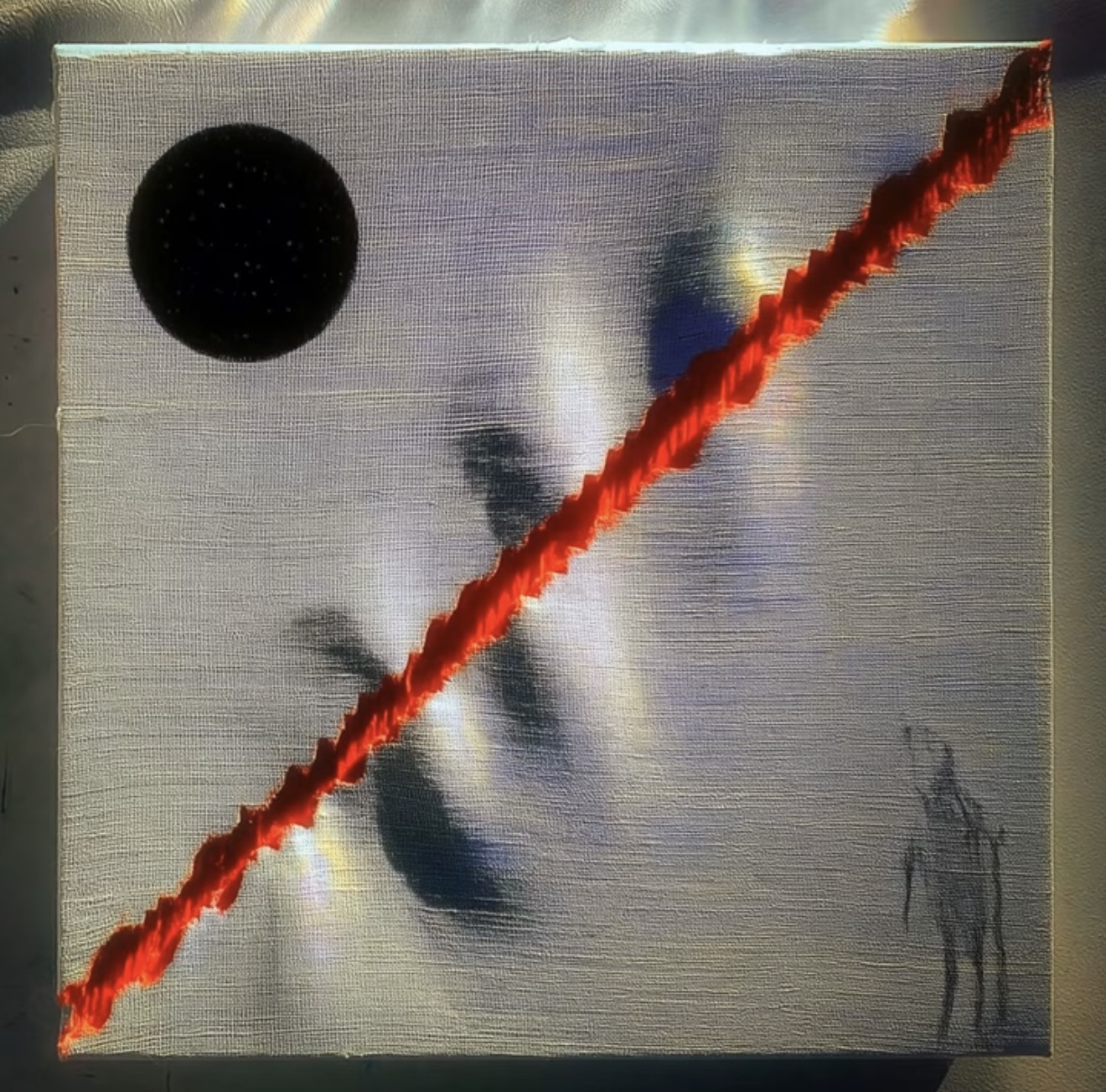
Panic Garden is pastels painted with a monkey’s paw. 7271 is Jackson Pollock with a switchblade. The hand holding the brush is the same.
Panic Garden
Panic Garden is a beautiful record: gentle, soft, spacious, austere without turning severe. A steady anxiety runs underneath it. Oakwood takes microscopic experiences (a touch on the wrist, a neighbor’s television, the number of cars in a parking lot, a plum tree flowering, rain on a window) and inflates them into enormous internal landscapes.
“saint of panic” sets the tone. For the first two and a half minutes it floats under a fragile, high-register vocal that often recalls Ryan Lott of Son Lux, singing about a thumb finding the soft place under something hard. Then the strings arrive, scratching and scraping in irregular gestures while the percussion runs in place and refuses to settle into a meter. The whole thing disintegrates into organized cacophony and stops short. I pictured a creature so used to mistreatment that one gentle touch becomes almost unbearable. Four grams of pressure, according to the lyric, and the music maps the delay before the touch is recognized and everything that recognition sets loose.
“slow bird leaving” is the surprise. Pizzicato strings and an irresistible guitar hook turn into a restrained, very effective rock groove. It’s like a generous pour of barrel-proof bourbon taken neat, all at once: sweet on the tongue, warm in the chest, burning in the ears, numbing the scalp, gone. It’s ear candy with real compositional intelligence underneath. The lyric is about disappearing (“if I disappear, let it be slow”), which sits oddly next to a hook this pleasant.
“The New One” is beautiful as a frozen lake. Delicate textures and a female vocal set up a fragile domestic intimacy while the narrator logs every small change: a voice that shifts half a degree in temperature, the same laugh track through the drywall, a new car in the parking lot. Then the music erupts like a bird trapped in a cardboard box. It’s hyper-vigilance, where harmless information becomes raw material for a major internal disturbance.
“root-dark” and “spring, comes” are the string-and-pluck pieces. Imagine Ryan Lott meeting the Kronos Quartet over a lovely acoustic groove, plucked strings against scratchy bowing. “spring, comes” scatters guitar, banjo, and mandolin-like gestures into acoustic pointillism, almost an algorithm of strumming and plucking. Audio popcorn. Gradually the fragments organize into a beautiful guitar groove, and the plum tree blooms without asking permission. The lyric gets a little explanatory when it insists the blossoms are actual blossoms and the aching is actual aching, but the music gives it room.
The instrumental “winter rain” closes the record, and it’s one of the best things on either album.
A virtuosic acoustic guitar sets up a deep modal groove with forceful hammer-ons and percussive attacks. Piano and guitar trade freely developing lines, then a long synthesizer passage brings in a tone like an electronic cello. Listening is like going through a bucket full of gemstones: every movement rearranges them and shows you new colors. I hear icy rain hitting a window from a warm room, sometimes forceful, and indifferent to whether anyone’s listening.
7271
If Panic Garden whispers its anxieties into a big interior room, 7271 drags them on stage, plugs in an amplifier, and starts dismantling the scenery. It’s heavier, angrier, and more theatrical, with progressive metal, math rock, noise rock, sludge, grunge, and a few passages that approach death metal. Calling it a metal album still misses the point. Oakwood borrows the weight, the distortion, and the screaming but skips the clichés, and even the most punishing stretches stay exploratory.
The lyrics start broad. “wonderful” gives us sun, moon, stars, a spirit in the soul and a demon in the bones. “Oh, Mama” opens with “God is dead” and “I am walking on his bones,” then spends the rest of the song asking whether you still believe and saying goodbye. It’s direct and obsessive, and the repetition is the point. By “love,” where the words arrive one per line and get sung that way, the record has turned ferocious.
“A moment of stillness” is a provocative title for a track with very little stillness in it. This is tortured Tool, System of a Down with a nail in its forehead, trying to peel itself off the wall. The guitar writing is abrasive and jangling, the rhythms fractured, yet there are deliberate decisions underneath about tension and where to put things. The lyric describes a moment of recognition more precious than all my yesterdays combined, and in the second verse “I” becomes “you” and “I died for you” becomes “you died for me.” The recognition runs both ways, and the music answers with almost unbearable intensity.
“all my mother’s tongues are drowning” shows another side. The chaotic passages bloom into soaring metal-ballad vocals, at times recalling Chris Cornell. The title is better than much of the lyric, and the repeated phrases look thin on the page. In performance they work: the words start by insisting “I know” and end up where language runs out, and the music carries what the words can’t.
“empty” is the most fascinating bit of sonic organization on the album. It opens in a wide stereo field with scraps of a groove scattered around, each gesture lost until they slowly find each other. The song coalesces like splattered mercury. Then, at the second “I’m just an empty vessel,” it drops the heaviest passage on the record.
Imagine Korn tripping acid with Jim Morrison during a live “Light My Fire,” covered by Mudvayne, with everyone rolling around on the stage. It’s gloriously unhinged. The narrator wants to dissolve without a trace and is, by his own report, still annoyed.
Throughout 7271, Oakwood treats the guitar as a source of texture, rhythmic instability, dissonance, and physical force. After the most violent passages the music tends to settle into an afterglow, the tension draining out into a golden release. That goes beyond the usual quiet-loud contrast. It lets you sit in the consequences of what just happened.
“sun-bleached eyes” ends the album. It starts with guitar harmonics suspended in a shoegaze stew, distorted ostinatos come in under ominous explosions, and eventually it turns grungy and sludgy. Think Bring Me the Horizon on a Quaalude, which sounds sleepy until you notice nobody in the room is asleep. Unlike the earlier tracks it isn’t particularly angry. It’s nihilistic, brutal, and realistic. The lyrics about memories you can’t keep, bleeding eyes, and being held under are delivered the way you’d talk about a rock or an interesting plant. Not indifferent, but not selling any spookiness either. There’s no obvious consolation. The final scream lands on “eyes” and holds for sixteen beats, and then it’s over.
One composer, two worlds
There are weaknesses. Some of the lyrics on 7271 lack the specificity that makes Panic Garden so affecting, the repetition sometimes runs long, and the intensity of the second album can be exhausting. The music’s sensitivity to texture and contrast mostly earns it back.
Underneath the different surfaces, the compositional imagination is consistent. Both albums are guitar-driven, 7271 more obviously, and both favor irregularity, unusual textures, and gestures that refuse conventional development. Both use a recognizable voice that moves from exquisite vulnerability to real force, and both leave room for the listener to bring their own experiences and finish the picture.