

My grandmother made quilts.
They weren’t the coordinated kind you see in country boutiques. These were huge patchwork things pieced together from whatever scraps were around: corduroy, cotton, denim, something floral, something striped, one inexplicable square of velvet.
They were heavy, rough in spots, worn soft in others. The batting inside eventually balled up into little lumps, and the whole thing smelled like the fabric, the house, and the years. You could spend an afternoon studying the squares and guessing where each one came from. Once you crawled underneath, they all turned into a single weight.
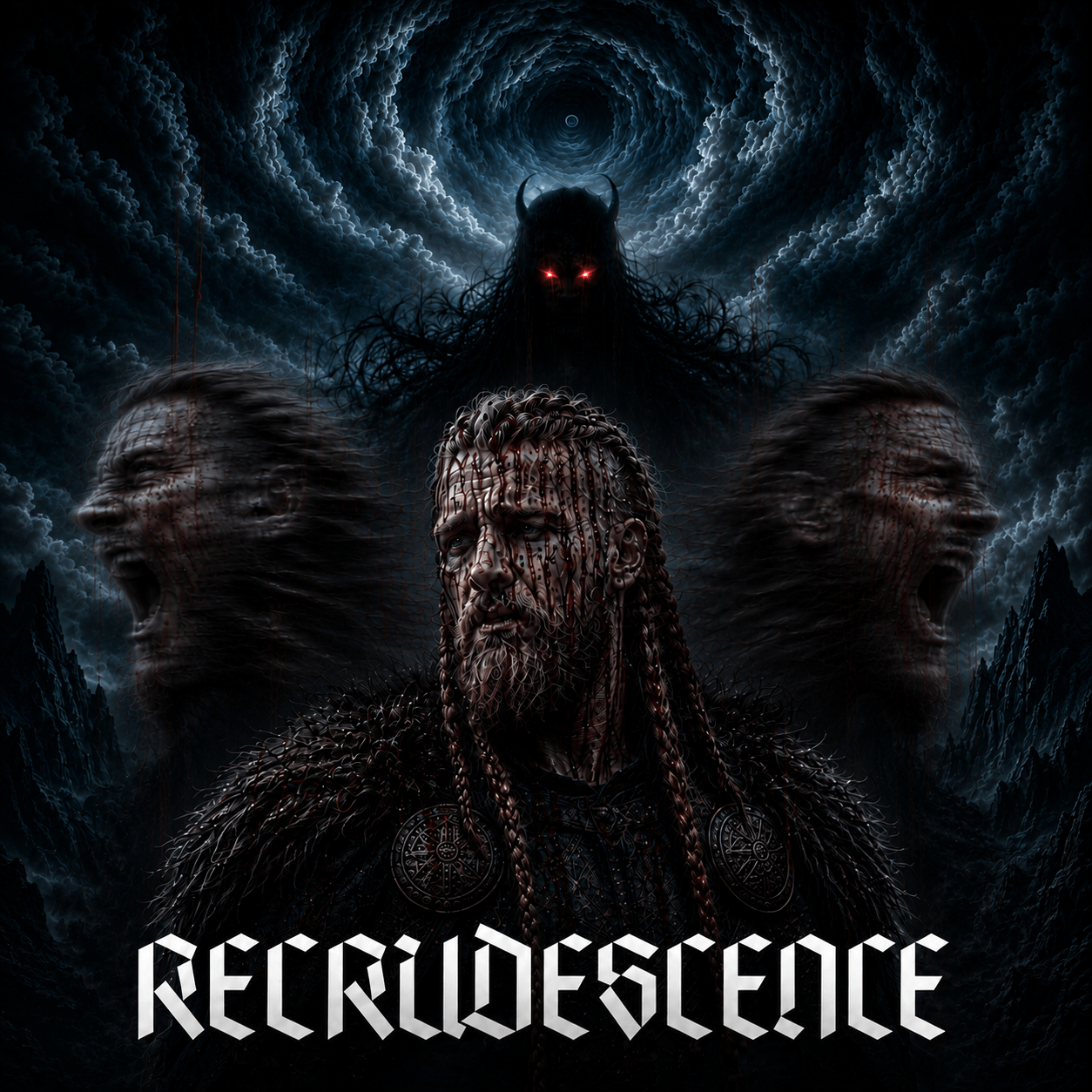
Vikingur’s long-anticipated sophomore album, RECRUDESCENCE, is that quilt.
The Fabric
This is a breakup album of epic proportions: 15 tracks, nearly two hours of romantic devastation, stitched together from just about every scrap of music its creator could lay hands on. Metal, orchestral writing, shoegaze, industrial, darkwave, hip-hop, psychedelic rock, Middle Eastern inflections, electronic dance rhythms, and some surprisingly delicate moments.
Let me settle one thing up front. This is a metal album. For all the wandering, it never leaves metal’s basic vocabulary: distorted guitars, double-kick drums, huge dynamic swings, guttural vocals, and an apocalyptic emotional scale. Everything else gets sewn into that.
And the collection of fabric is impressive. Vikingur’s appetite for sound is close to indiscriminate. There’s beautiful orchestration, terrific guitar textures, carefully suspended silences, pulsing synths, delicate piano, and percussion that can turn a track into a physical assault. The production is often spectacular, and the arrangements can be remarkably sophisticated.
Sophisticated arrangement and sophisticated composition aren’t the same thing, though. These pieces are episodic, mostly through-composed, and not much interested in conventional form. Hooks and recurring themes do show up, just not often enough to give pieces this long a dependable architecture. Sections pile up. Textures shift. Something explodes, something dissolves, something beautiful crawls out of the wreckage. At times, that’s breathtaking. Sometimes it’s just too long.
That’s where the quilt starts to be a problem. Contrast needs hierarchy. A delicate piano passage means more when we can hear how it relates to what surrounds it. A death-metal eruption hits harder when something has prepared us for it and its effects reach past the next transition. When every square demands equal attention, the eye stops telling them apart.
"BLACKENED ECLIPSE." shows this clearly. It has enough good ideas for several songs, but the jazz-inflected passages, metal eruptions, dramatic vocals, and instrumental excursions all compete without settling into any order. Every piece of fabric is good, and the finished blanket is harder to remember than any single one of them.
Vikingur does have a real instinct for dramatic timing, and it can be thrilling. In "VOWBREAK.", huge pauses cut the momentum dead. It’s like a stunt cyclist launching off a ramp into open air: for a moment everything vanishes except the implied heartbeat, until the wheels come down. That’s effective musical theater, and it tells me he understands anticipation and release even when the larger structure gets away from him.
The Weight
"REMEMBER.", featuring Ghost Ryder, pairs a powerful metallic assault with the album’s first real lyrical complication. Up to this point the abandoned lover has mostly cast himself as the injured party. Here, frightening memories of his own behavior come in. He remembers shouting, hurting himself, scaring his partner, and wearing down someone who was trying to hold the relationship together. The breakup stops being so simple.
Unfortunately, that complication never grows into sustained self-examination. The album’s emotional vocabulary is much narrower than its musical one. Over nearly two hours the narrator moves through abandonment, accusation, self-loathing, longing, resentment, and fantasies of disappearing or revenge. There are moments of accountability, but there are also repeated attempts to make the ex responsible for all of his suffering.
In "UNRAVELING.", the beloved becomes something close to a deity, then gets condemned for turning out to be human. PapaD’s contribution brings in grief over a father’s death, which puts two very different kinds of loss side by side. I understand the emotional connection. I’m just not sure a breakup and a death belong on the same scale, and the album doesn’t make the case that they do.
"ISOLATED.", featuring NeuroDreams, is better. The Turkish and English lyrics sound like two people who no longer speak the same emotional language, each in a separate room rehearsing what they wish they could say. It’s one of the album’s most successful dramatic ideas. The song isn’t a quilt, either. It’s an old, scratchy, dark-green army blanket. It’s the TV running in the background while an internal monologue gets too loud to ignore, and it sounds like someone licking wounds that were never allowed to close.
That’s also where RECRUDESCENCE gets difficult, because it’s uncomfortably familiar. I don’t mean the style. I mean the experience. Anyone who remembers the out-of-proportion agony of an early heartbreak will recognize the obsessive thinking, the endless arguments with someone who isn’t there, the conviction that nobody has ever hurt this much.
This is a young person’s album. I don’t mean that as a dismissal. The scale of the feelings, the insistence that they matter more than anything, and the difficulty of picturing a life past them are all recognizably youthful, and the naïveté and the sincerity come as a package. But sincerity doesn’t automatically make compelling art.
By "GORE.", the narrator’s humiliation has curdled into revenge fantasies. He no longer just wants to be heard; he wants to be impossible to ignore. By "COLLAPSE.", the music is a punishing death march of sadness, a long pile-up of sonic violence and emotional distress. "I DON’T WANT IT." adds more self-condemnation and suicidal imagery, plus a few beautiful passages that give the listener some badly needed room to breathe.
By then the fatigue is real. The album is so relentlessly internal that I stopped feeling like a witness to someone’s suffering and started feeling like I’d been drafted into it. There’s a ton of musical momentum here and very little emotional movement. At some point you have to ask whether music that gives suffering such a huge voice has also given it somewhere to go; a place to safely exist.
The Unraveling
Then comes "VANTAHEART", which for me is the most musically satisfying track on the album. It’s a huge metal ballad featuring Hollow Idolz, and it has the thing so many earlier tracks lack: a memorable hook. The sliding vocal transitions, exposed a cappella passages, halftime percussion, and gently psychedelic synth textures add up to one beautiful, engaging moment after another. It takes risks, and they mostly pay off.
Lyrically, though, we’re still in the same gravitational field. Vikingur widens the imagery to spacetime, singularity, and cosmic dissolution, but the emotional destination is the same. The music finds new territory while the narrator keeps circling the same wound.
After 14 tracks I wanted something to change. Not reconciliation or redemption or a happy ending. Even an acknowledgment that life goes on would have done it.
And then, somewhat unexpectedly, it does. The bonus track, "UNDERGROUND.", is a tribute to the AI:Underground community, especially to its co-founders Ghost Ryder and Vvxn. Vikingur describes the people who accepted him, supported him, and gave him a place to belong.
I know this community. I know Vikingur as an enthusiastic Friday-night listening-party host and a generous supporter of other musicians, and his affection for his friends is returned in full. I’ve watched him build a respected place in AI:Underground, so when he thanks people for accepting him, I believe him. Here, finally, the narrator looks past the person who left and sees the people who stayed.
The song is hardly restrained. It ends with some of the most extreme death-metal vocals on the album, because Vikingur is still Vikingur. But the gratitude reads as real, and the emotional shift is unmistakable. It says something that it arrives as a bonus track and not as the end of the album proper.
RECRUDESCENCE is extraordinary, excessive, often beautiful, and sometimes maddening. The musical imagination is huge, the formal discipline is uneven, and the emotional world is almost suffocatingly small. I admire the ambition. I admire that it shows ugly feelings without making them attractive. I admire the sonic invention, even when I question the compositional decisions holding it together.
But after nearly two hours under this quilt, the weight gets to be too much. The beautiful squares are still beautiful, the stitching is sometimes ingenious, and the fabric holds memory, anger, tenderness, and pain. Eventually I just need to kick a leg out from under it.
When "UNDERGROUND." finally lets in some daylight, I realize how long I’d been waiting to breathe.