

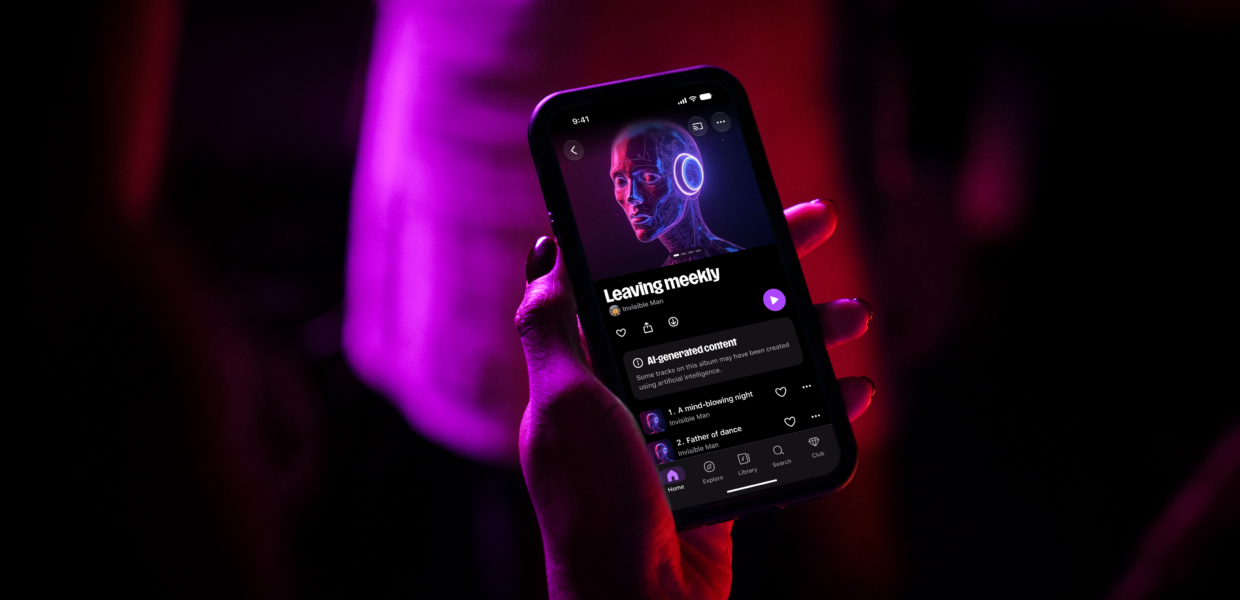
Deezer announced today that it will roll out a global on/off toggle before the end of 2026 that removes fully AI-generated tracks, albums, and their associated artists from search results. Deezer already keeps detected AI tracks out of algorithmic recommendations and editorial playlists, so search was the last open path to those tracks on the platform. For listeners who flip the switch, that path closes too. The release describes users activating the setting, which suggests it’s opt-in rather than on by default.
The numbers behind the move keep climbing. Deezer says it has excluded more than 42 million AI-generated tracks from recommendations between January 2025 and August 2026, tagged over 14 million albums, and now receives nearly 90,000 fully AI-generated tracks a day, more than half of all deliveries on peak days.
CEO Alexis Lanternier pointed to demand, saying, “We’ve seen a clear user demand for the ability to filter out AI-generated music,” and the company cites its Ipsos study finding that 45% of streaming users want that option.
This is a meaningful shift in Deezer’s logic.
When Zinstrel sat down with Chief Innovation Officer Aurélien Hérault in Paris this summer, the throughline was that Deezer targets fraud, not AI, and the fraud case is still strong, with Deezer reporting that up to 85% of streams on fully AI tracks were fraudulent in 2025. The toggle isn’t a fraud filter, though. It’s a taste filter, and it treats a legitimate AI-native artist exactly like a stream farm. It also filters something most listeners can’t perceive, since the same Ipsos study found 97% couldn’t tell AI from human music in a blind test. What gets filtered is the label, not the sound.
That puts real weight on the line between “fully AI-generated” and AI-assisted, which Deezer says it handles differently. Deezer AI detection tech is trained on signatures from Suno, Udio, and other generators and is now licensed to the wider industry, so a filter built on it could travel well beyond one platform. For tool builders, workflows that keep human performance, stems, and editing in the loop just became a distribution advantage, not only a creative one.