

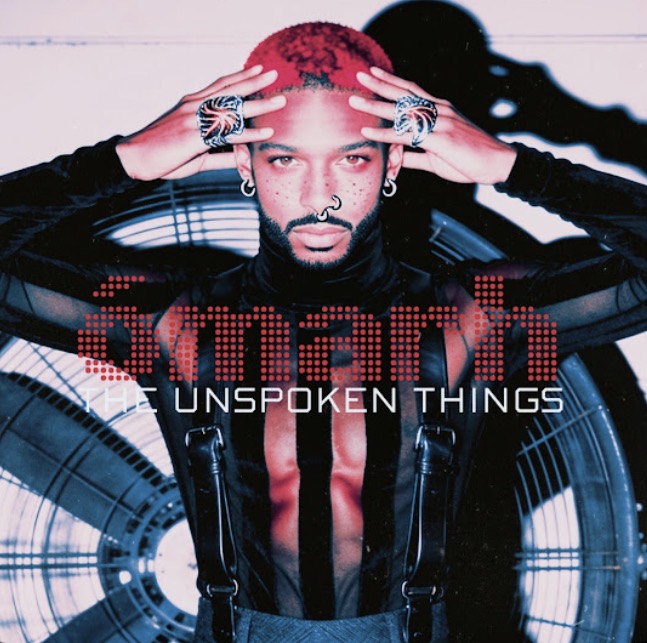
Ómarh's The Unspoken Things is vintage R&B and knows it. Prince, Usher, Jodeci, Ginuwine, Boyz II Men, and Musiq Soulchild are all in the room: familiar grooves, lush stacked harmonies, bedroom seduction, romantic frustration. Much of it is done very well. Some of it is a little too familiar for its own good.
Press Play
“Waitin’” sets Ómarh up as an expressive, soulful vocalist with the melismatic delivery of the great male R&B singers of the late eighties and nineties. There’s a gospel-style command of the voice here, pointed in a decidedly secular direction. This guy is trying to sing you into the bedroom, not onto the altar.
“Press Play” gets funkier. It’s Ginuwine’s sensuality over rubbery bass and synth work out of Parliament-Funkadelic and early Prince, with a little Dirty Mind and Controversy in the arrangement. Cheeky, funky, and it knows exactly what it’s doing.
“Strawberry Dawn” changes the scenery: wind chimes, clean jazz guitar, beautifully stacked background vocals, and a warm, almost tropical feel. The vocal arranging reminded me of Level 42’s “Something About You” (the arranging, not the style). There’s also some unexpected harmonic movement that lifts it above the usual slow-jam vocabulary. The arrangement is warm while the lyrics suggest darker circumstances, then turn toward renewal.
“Hard to Do” is a straight romantic ballad that wouldn’t have been out of place on a Boyz II Men record. It’s the first track that struck me as generic, though the lyrics are more complicated than the music. A man argues with himself about betrayal, forgiveness, pride, attraction, and whether to stay or go. Familiar situation, ordinary setting.
“Bad as You Are” brings the funk back with psychedelic synths, a sensual groove, and a hook that sticks. The lyrics live where desire and resentment overlap. It’s one of the most memorable tracks here.
By this point I’d noticed something I consider fundamental to good songwriting: economy. Nothing is overstated, stretched out, or padded. Even the conventional tracks know when to stop, which isn’t easy in music built on repeating grooves, long vocal runs, and choruses designed to linger.
Not What You Said Last Time
“Not What You Said Last Time” kept that going at first. Between the 808 percussion and that glorious synthetic cowbell, it could have come out in 1985. I kept hearing Shalamar and Klymaxx, and picturing this as the opening act at a Kool & the Gang show around 1987. Catchy, cool, thoroughly nostalgic.
The vocal setup is worth a note. Most of the album sounds like a male vocal group: one consistent lead, thick harmonized backgrounds. If the lead changed now and then, you’d swear it was Boyz II Men. Instead Ómarh keeps one central voice throughout, so it feels like an ensemble built around a single personality.
This is also about where the album starts losing its individuality.
“Not What You Said Last Time,” “Heartthrob,” and “Don’t Just Say My Name” ran together for me. Nothing objectionable, and the performances are solid and the production polished, but whatever made the first several tracks distinct got harder to hear. “WWF (Why We’re Fighting)” brings some welcome freshness, but the album never regains the momentum of its opening.
The title track is sultry, sexy, and fairly middle-of-the-road. “Somebody Loves You” is sweet and a little too safe. “U Know” goes back to early Prince, filtered through Boyz II Men’s arranging and Usher’s more provocative streak. It’s catchy and trying to turn up the heat, but it’s not as dirty or dangerous as the music seems to want. “Needs” is a lascivious slog, just dirty enough to qualify as adult contemporary. “Whatever’s Clever” picks up the pace and suggests a reconciliation after the previous track, but by then the ideas are mostly spent.
That’s my main complaint. There’s plenty of good music here and very little that’s badly made. The problem is cumulative. Fourteen songs over sixty-four minutes keep working the same territory, so the album is bloated even though the songs aren’t.
The Unspoken Things
What kept me listening anyway is that over fourteen songs, I feel like I got to know Ómarh.
He’s a yearning guy, forever trying to work out how to deal with another person. Sometimes confident, sometimes insecure, sometimes tender, sometimes selfish. He wants sex, affection, forgiveness, reassurance, and now and then a little peace. His love life is lust, love, boredom, conquest, disappointment, and making up.
Sometimes they fight, sometimes they fuck, sometimes they love, sometimes they walk away. Most of us have been somewhere on that spectrum.
These aren’t grand declarations from a man with everything figured out. They’re attempts, failures, negotiations, and the occasional win from someone trying to make a relationship work, or at least get what he wants from one. The songs cover enough sides of intimacy that the protagonist becomes familiar, even when the settings start to sound interchangeable.
That’s where the title makes sense. The Unspoken Things is all the feelings, desires, and resentments people carry into relationships without knowing how to say them. Sometimes they become ballads, sometimes arguments, sometimes sex.
Ómarh clearly loves the tradition he’s working in and understands what made it effective. The grooves are convincing, the vocal arrangements are frequently excellent, and the production is polished without sanding off all the funk. At its best, it recalls some of the finest vintage R&B.
I just wish he’d been more selective. A tighter album is hiding in these sixty-four minutes. A few fewer songs, more contrast, and a willingness to leave the safe corners of the genre would have made this a considerably stronger record.
I still came away liking Ómarh and pulling for the guy in these songs. He doesn’t always find the right words, or know what he wants, but he keeps trying. To me, that makes the journey all the sweeter.