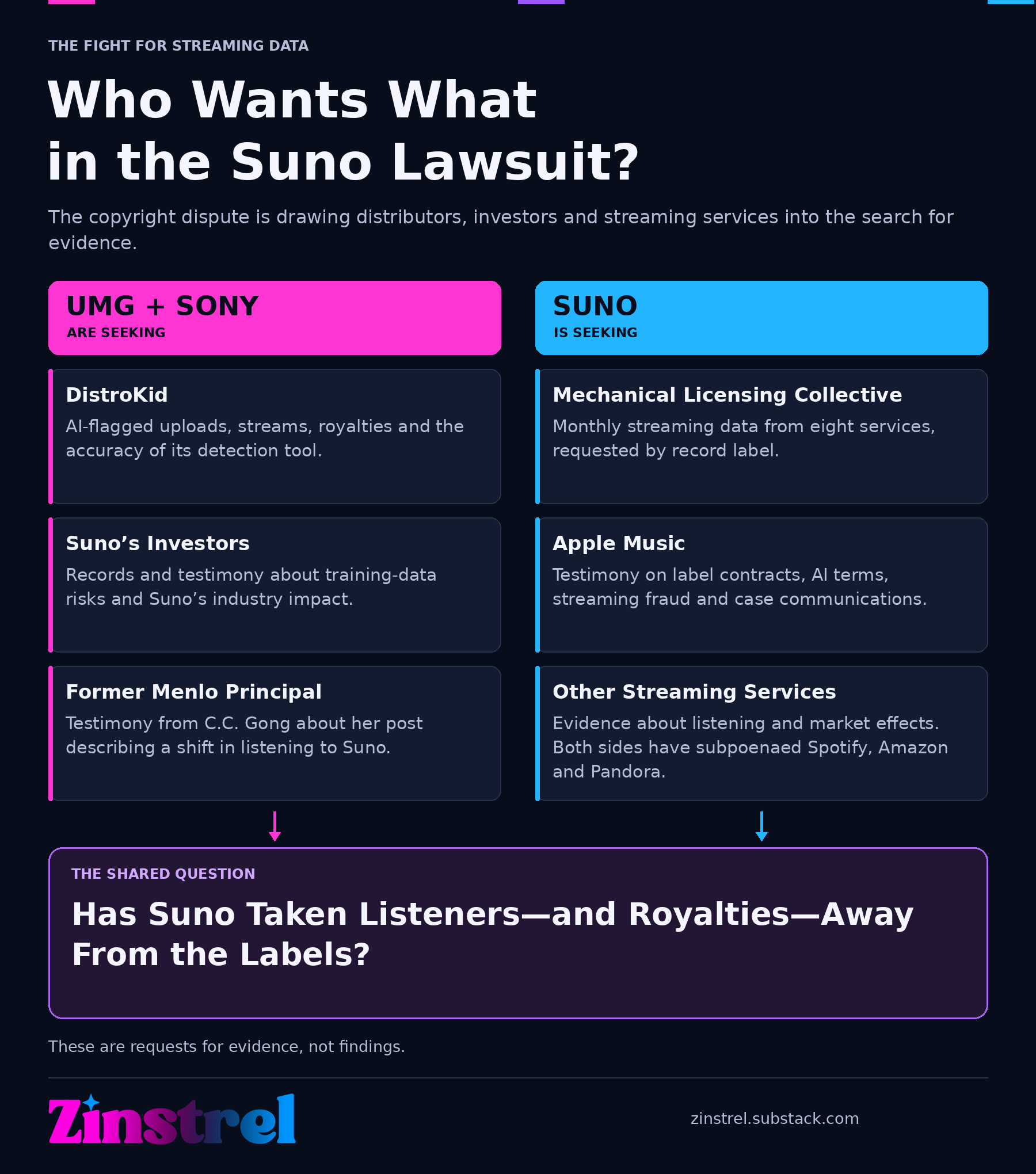
Universal Music Group and Sony Music’s copyright lawsuit against Suno has spilled out well beyond the two sides. Both have been sending subpoenas, legal demands for documents or testimony, to streaming services, a royalty organization, a distributor, investors, and even a former investor employee. Almost every one comes back to the same question: has Suno’s music actually taken listeners and royalties away from the labels, or have their contracts and anti-fraud efforts protected them? The answer matters because Suno’s main defense is fair use, and whether a use hurts the market for the original work is a big part of how courts decide fair use.
The labels’ biggest target is DistroKid, the indie distributor. They went to court in Manhattan on Oct. 14 to force it to answer a September subpoena, saying DistroKid refuses to produce a single document. They want to know how many tracks DistroKid sent to streaming services each month, how many its AI-detection tool flagged as likely AI-made, and how many streams and royalties those tracks earned. They also want to know which detection tool DistroKid uses and how accurate it is. According to the labels, DistroKid’s position is that the case is only about how Suno trained its models, not about what happened in the market afterward. The labels’ filing says DistroKid delivered nearly 12 million tracks to one unnamed streaming service between March and September, more than every other distributor combined. DistroKid now has until Nov. 6 to respond, and both sides have told the court they’re trying to work it out.
The labels are also going after the people who funded Suno. Lightspeed Venture Partners, which invested in three of Suno’s funding rounds, has asked the court to throw out its subpoena. It says the demands are too late and too burdensome, and points out that it already handed over 152 documents totaling 1,259 pages. The labels, in their opposition, want records about the risks of Suno’s training data, and testimony on 20 topics, including Suno’s effect on the music industry. They’re also pressing Bond Capital and Menlo Ventures, and a judge has approved questioning former Menlo principal C.C. Gong under oath about a social media post she later deleted.
“I’ve personally shifted most of my listening to Suno,” Gong wrote.
Suno didn’t oppose that deposition. It did point out that the subpoena came 12 days after the deadline for gathering evidence on most of the claims, and said Menlo and Gong may still try to block it.
Suno’s own demands come at the question from the other direction. It wants the Mechanical Licensing Collective (MLC), which collects songwriter royalties from streaming services, to hand over monthly play data from 2021 to now for Amazon, Apple, Deezer, Pandora, SoundCloud, Spotify, Tidal, and YouTube, broken down by label. Udio has asked for nearly the same thing. The MLC says the request is vague and too broad, that it doesn’t track data by record label, and that streaming services have objected. Suno’s lawyer says the MLC had agreed to provide the data and quoted a price, about $5,000 that Suno would pay, then suddenly reversed course and refused. Pandora told the MLC back in July that it does not consent to sharing its data. The MLC has to file its response by Monday, Nov. 2, and Suno replies by Nov. 16.
From Apple, Suno wants testimony on four things: Apple Music’s current contract talks with UMG and Sony, including anything about AI; whether Apple Music could survive without those labels’ catalogs; how much streaming fraud happens on the service; and what Apple and the labels have said to each other about the case, including through the RIAA. Apple says the topics are irrelevant, overbroad, and disproportionate. Suno’s theory, laid out in its opposition filing, is that the labels’ streaming contracts already guarantee them minimum payments and keep AI music out of the royalty pool, so AI can’t be eating into their earnings. It also argues the labels are abusing their copyrights by using their must-have catalogs as a cudgel to extract broad, anti-AI concessions from DSPs. Apple’s response poked a hole in the first half of that argument.
The company “does not currently exclude AI-generated content from its royalty pool,” Apple’s motion said.
Apple also revealed that it started using its own AI-music detection tool in March 2026, and that it has already given both sides a spreadsheet of Suno-made tracks and how often they’ve been played. It said both sides have subpoenaed Spotify, Amazon, and Pandora too. A federal magistrate judge in California will hear Apple’s request on Dec. 1.
UMG’s own earnings call on Oct. 29 helps explain why Suno wants Apple on the record. CEO Lucian Grainge told investors that UMG has added protections against AI diluting royalties to its streaming deals, and that those deals need to change. Chief Digital Officer Michael Nash named YouTube and Spotify as partners with those protections, but not Apple. And when CFO Matt Ellis talked about Apple’s recent price increase, he said there’s not a 2.0 agreement there yet.
In other words, UMG’s next deal with Apple is still being negotiated, and AI terms are part of what UMG wants. Some of the numbers also help Suno’s side. Apple Music’s Oliver Schusser said in April that AI music makes up less than half a percent of listening, even though more than a third of the music uploaded each month is fully AI-made. And back in February, Nash told investors that AI was an insignificant risk to UMG’s revenue.
However the judges rule, this round of fact-finding could finally produce something the AI music fight has been missing: real numbers, from the platforms themselves, on how much AI music people actually stream and how much it gets paid. Both sides have been making claims about that for two years without showing the data.