

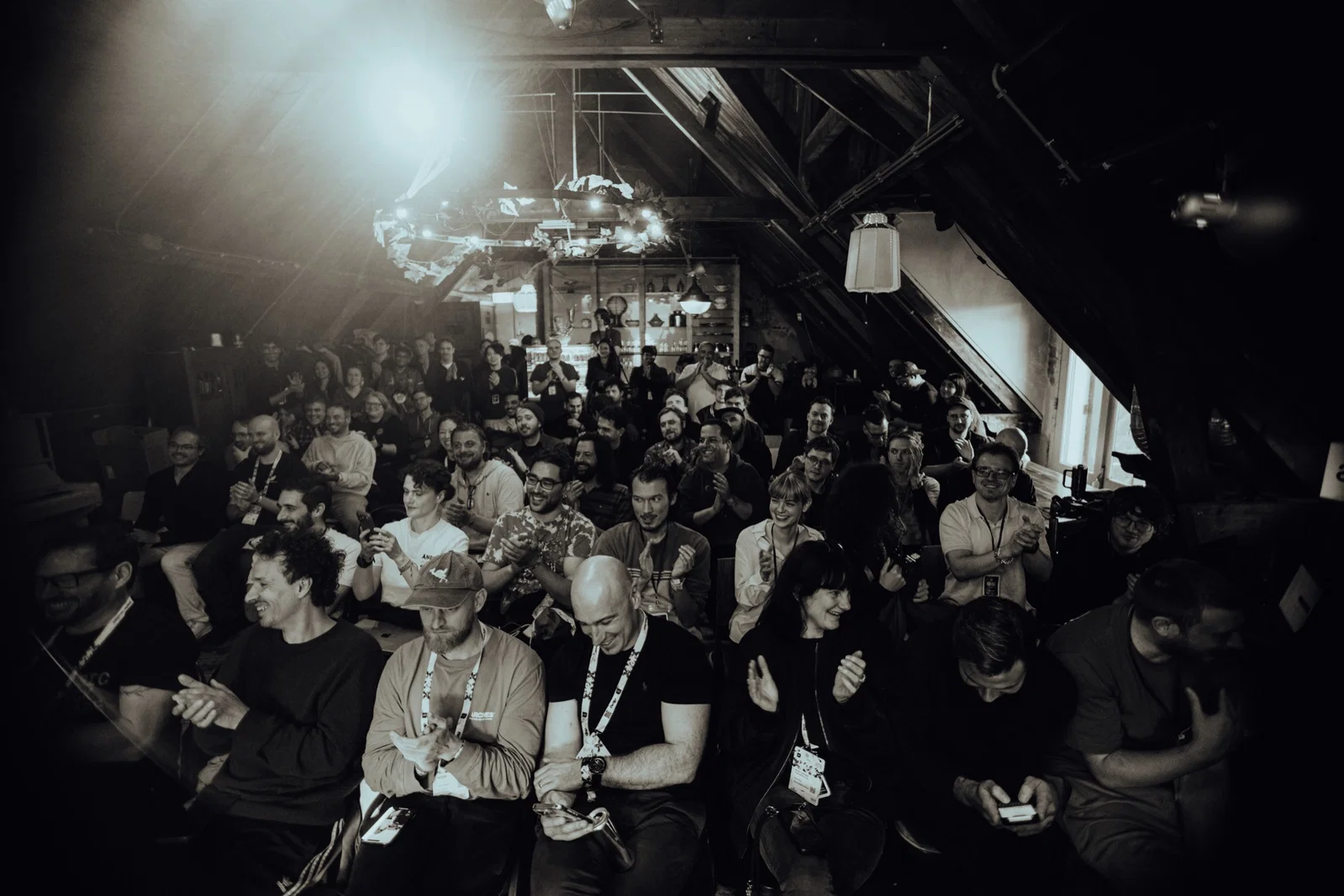
Music Hackspace’s official ADE Lab Hackathon wrapped in Amsterdam Oct. 23 as part of Amsterdam Dance Event, and two of its four challenge tracks put AI at the center: one aimed at the business side of music, the other at generative audio.
The event, capped at 100 participants, gave teams 36 hours to build at De Bakkerswinkel Westerpark, with winners named Oct. 22 and exhibited publicly the next day.
Dutch DJ-producer Sam Feldt, who runs Heartfeldt Records and has built his own software for contracts and royalty auditing, asked teams to build an AI co-pilot for running a label. He gave them read-only access to his own codebases and a mock catalog of fictional releases and contracts seeded with deliberate errors.
The winner, Absorb, pitches itself as a “release coach” that walks artists from a finished track to getting paid, checks incoming royalty statements against their contracts, and shows the evidence when something doesn’t match. Run against the challenge’s planted data, its rules flagged 15 errors worth €4,431 across 11,674 statement lines. The team stresses that the dataset was built to contain errors, so that isn’t a real-world rate. Absorb doesn’t collect royalties itself. Its plan is a free tool for artists, paid tiers of €49 to €399 a month for labels and managers, and a 15% fee on money it recovers. The team, led by Tal Shany, says it would raise a €600,000 pre-seed round. B-Side, a record label platform, placed second.
Stability AI’s track asked for public tools built on Stable Audio 3, its new family of open-weights models. Winner Generative Gallery turns an art gallery into a continuous soundtrack heard through headphones. A curator uploads an artwork, an AI language model interprets its image and meaning into a music prompt the curator can edit, and Stable Audio generates the recording. The system then uses inpainting to generate transitional music between two artworks, so the sound shifts as visitors walk between them, tracked by Bluetooth beacons. A handheld controller lets visitors register how a piece makes them feel. The curator tools work now; connecting the visitor side is the next step. “Any museum or interactive art experience should have this,” Feldt commented on the project page.
Quarks Jam, billed as an offline jam club, and SCULPTRO placed second and third in Stability’s track. Setlist won Algoriddim’s DJ workflow challenge, and TronGrid won modular synthesist Colin Benders’ “Escape the Grid” challenge. Teams keep full ownership of what they built.
Stability AI CEO Prem Akkaraju takes the stage this week at Music Tectonics, which Zinstrel is covering on the ground.