

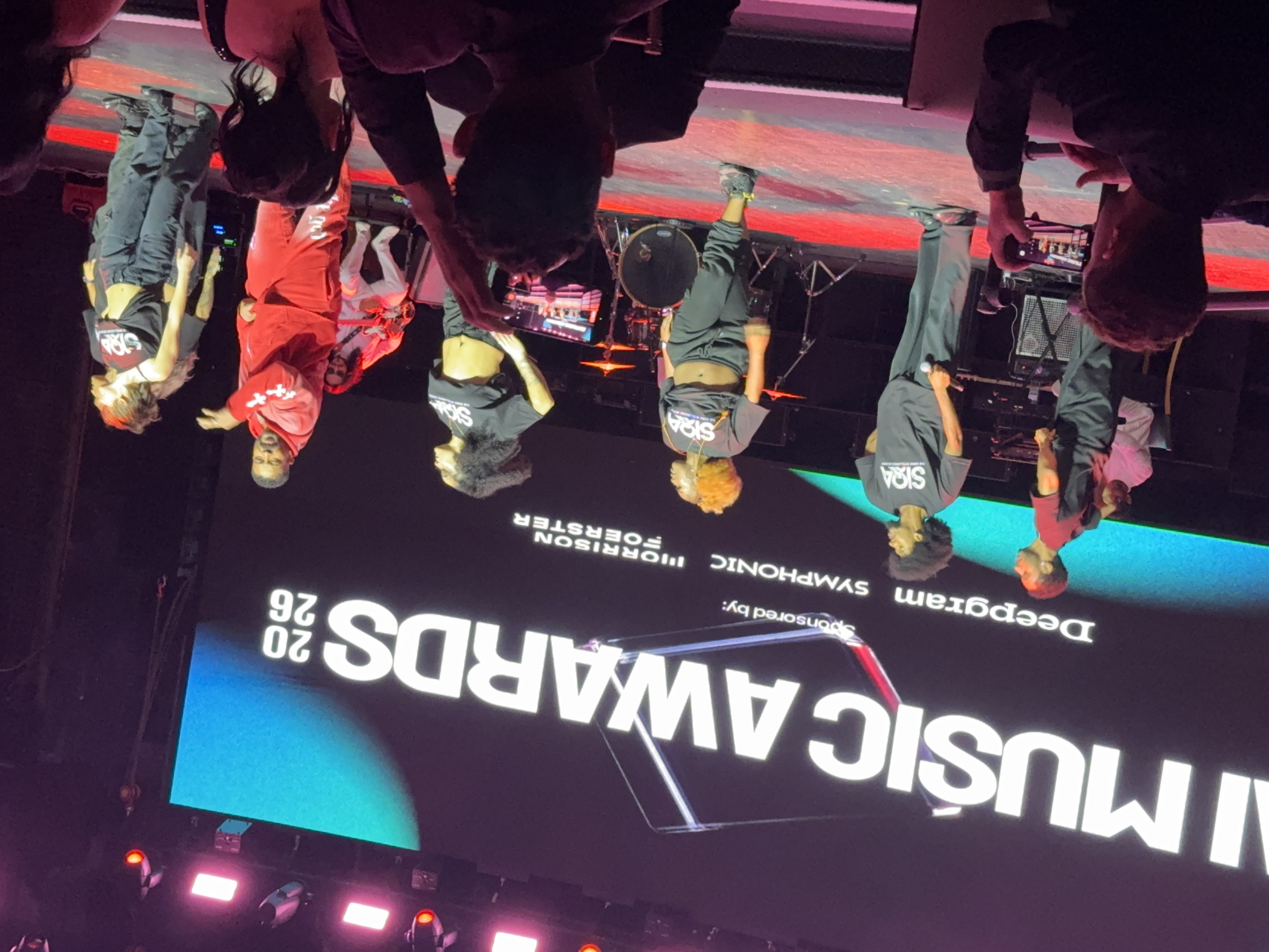
Hardly anyone who covered the first AI Music Awards came away talking about the AI. Variety wrote about missed cues and lip-synced sets. Reuters chose to focus on the people behind the songs. On r/Suno, viewers argued over what "live" means when the music is generated.
The first-ever AI Music Awards was historic no matter how you look at it. It was the largest gathering of AI music creators and enthusiasts in history (so far), and provided both a space and a mechanism for honoring this new class of artists. Telisha "Nikki" Jones's Xania Monet took home AI Song of the Year, AI Artist of the Year, and Best AI R&B Artist. (Read Zinstrel's recap and full winners list.)
Since the Friday the 13th awards show wrapped, reactions have been coming in from mainstream media outlets, independent publications, and individual industry watchers — each giving a different take on what was important about the night.
Taken together, the coverage shows an evening of equal parts chaos and genuine excitement.
Here's what they're saying. My take follows below.
"And the Award Goes to ... AI Music" (Reuters)
Reuters went to the red carpet and listened. Across a wire story and a separate set of red-carpet interviews, Lisa Richwine and Rollo Ross barely touched the missed cues. Their thesis came from producer Drake Murphy, presenting Best AI Hip-Hop Song:
“In a world where everybody calls AI fake, the human behind it is real.”
Nominees told them they had stories to tell but not every skill needed to set them to music, and that AI closed the gap. J. Frequency, featured on DJ Shawn Q’s Best AI Collab winner “No chains left,” said the work is harder than people assume. Jones said she wrote every lyric for Xania Monet. Reuters set all of that against label lawsuits over training data, a new suit from the Elvis Presley estate, and musicians’ fears of lost work, and noted that the winners were chosen by members of SIQA, which also runs AI music charts. (Read the Reuters story, and the red-carpet interviews via TV5.)
"A Chaotic Evening" (Variety)
Corbin Bolies, who moderated the SIQA Summit fireside chat with will.i.am the day before, filed the night’s most critical account: a wry, first-person feature. His summary of the whole enterprise: “It is, in a word, new, and new things mean kinks to work out.”
The kinks started at the door. Bolies arrived to find the venue locked and no security in sight. The show started about half an hour late, skipped nominee introductions for the first half of the awards, and ran roughly 40 minutes behind all night. The hosts lost track of what came next, at one point walking back out mid-introduction to call a commercial break. The teleprompter kept jumping. By the time he left after 10 p.m., well past the scheduled 9:30 finish, the crowd had thinned.
The performances, he wrote, brought some of the night’s best energy, mostly through lip-syncing and acting. Ava Bentley and EJ Rogers lip-synced their entire sets, and a 14-year-old named John Victor lip-synced for AI character Chaisen Hale. Some of the only live vocals came from GodFellow, Eric Bellinger, and Candace Wakefield, who sang Aria Blu’s song live.
Still, Bolies left room for the people the show was built for. On the red carpet he met Ramona Höffel, a 56-year-old who spends her days helping disabled people and flew in from Switzerland to represent her project, Vireya, on her first-ever red carpet.
He closes unsure whether AI music will become a lasting cultural moment, but certain the night left people like Höffel feeling stronger. (Read Variety’s report.)
Other Reactions
The harshest reviews came from inside the AI music community. On r/Suno, commenters called the ceremony a “clown show” and a “train wreck,” and some described it as pay-to-play (SIQA doesn’t charge creators to join its Registry or to vote). Others dismissed the whole thing as an “insular exercise in self-validation,” and a few defended it for putting “people, not personas” at the center. Two creators wrote to Zinstrel anonymously. One, whose AI project has millions of listens, said, “For all those who mock AI music because it’s fake, not real, and takes no talent, we just proved them right.” The other struggled with accessing the livestream and called it “a total disappointment.” Artificially Intimidating’s Nicholas Rhodes questioned how much a verification label can prove when entrants report their own AI use. DEV Community’s Serghei Pogor called for a full dress rehearsal, someone responsible for every cue, and a plan for what to cut when the show runs late.
Zinstrel's Take
Disclosure: I serve on SIQA's Creative Advisory Council, helped plan the SIQA Summit, moderated two panels on Thursday, and co-presented two awards on Friday with Christopher Wieduwilt. Neither I nor Zinstrel had a role in nominations or the event production. Zinstrel columnist Rob Schultz was nominated for Best AI Pop Song.
We need to give credit where it's due. The Sonic Intelligence Academy did something nobody else dared do in this AI-skeptical age: throw a party and celebrate some artists who are making an impact. The event brought people from around the world into one room, celebrating the new creator class that has emerged, giving countless millions a novel way to express themselves. That shouldn't be discounted.
It gave the AI music community an excuse to put together the SIQA Summit, a day-long conference that addressed topics such as monetization for AI artists, how to reach the next generation with the music being made, and the hidden AI music communities online. Not to mention, it brought The Black Eyed Peas Founder will.i.am to the room to address the group.
The awards themselves were a Friday the 13th roller-coaster.
At times, they were energetic, exciting, and encouraging. Other times, they were chaotic, disjointed, and disorganized. SIQA's small team faced an enormous task, and ultimately, a number of errors — avoidable and unavoidable — made the AIMAs' first outing somewhat difficult.
When Jones won Song of the Year, the lead-out music came up over her acceptance speech. She kept talking. Almost nobody could hear her. If there's a second AIMAs, start there. Give the performers a proper soundcheck, give the nominees their names, give the nominated songs a chance to briefly be heard in the show, give the winners their microphones, and see how many of the people who walked that carpet get hired to make something after it's rolled up.
If there is a second-annual event — which we fully expect there will be — planning will have to start much earlier, and a number of adjustments will need to be made. Starting with the venue, which repeatedly showed with its A/V team that it didn't respect the people onstage nor the run of show.
It would be easy, though, to point fingers and sneer at the sometimes-troubled ceremony. That would be unfortunate. We're seeing SIQA take big risks with AI music culture while the scene is still early, and when few sponsors (outside of Deepgram, Morrison Foerster, and Symphonic) would publicly and financially stand with them. They largely had to go it alone. And most people when faced with that would shy away from the spectacle. SIQA didn't want to wait.
The growing pains are real. But so was the desire to grow this tranche of the creative community.
As someone deeply invested in this space, what will stick with me won't be the troubled ceremony itself. It was the interactions between artists who had never met in person. It was the conversations that could only happen when you get past defending AI music and start accepting it. It was the gratitude of the artists who found a safe place to not only share their music, but be honored for it.
At The Mayan, Olivia B Moore read a poem, let a dancer carry "Love Notes," and handed out handwritten notes. Wakefield stood at a mic and masterfully sang Aria Blu's AI song live. And Eric Bellinger sang live alongside the human avatar of his AI singer Aries Ivory, blending live and AI. Those were three very different answers to the question viewers kept asking about how this music would play onstage. They gave us a glimpse of what's possible, while knowing there's so much more to come.
The work for 2027 begins now.