

I decided to test AI's ability to build a DJ set, and I gave myself one rule going into this: no cheating.
If an AI tool suggested a track, a transition, or an original drop, I had to use it as given, or note exactly why I didn't. No quietly swapping in my own picks and calling it an AI set. If this was going to be honest, it needed to be uncomfortable.
Thirty years of DJing has taught me one thing above all else: a set only works if the room agrees with it in real time. So the test wasn't whether an AI tool could produce a tracklist. It was whether that tracklist could survive contact with an audience.
That audience was a small private party of around a dozen people, most of whom I knew. It wasn't a club, and it wasn't a paying crowd. I wasn't going to put an experiment in front of a promoter's night or a booking I'm paid to deliver. But it was a real room, reacting in front of me.
The Brief
I picked a straightforward starting point: a two-hour house set, warm-up to peak time, the kind of shape I'd build for one of my radio shows.
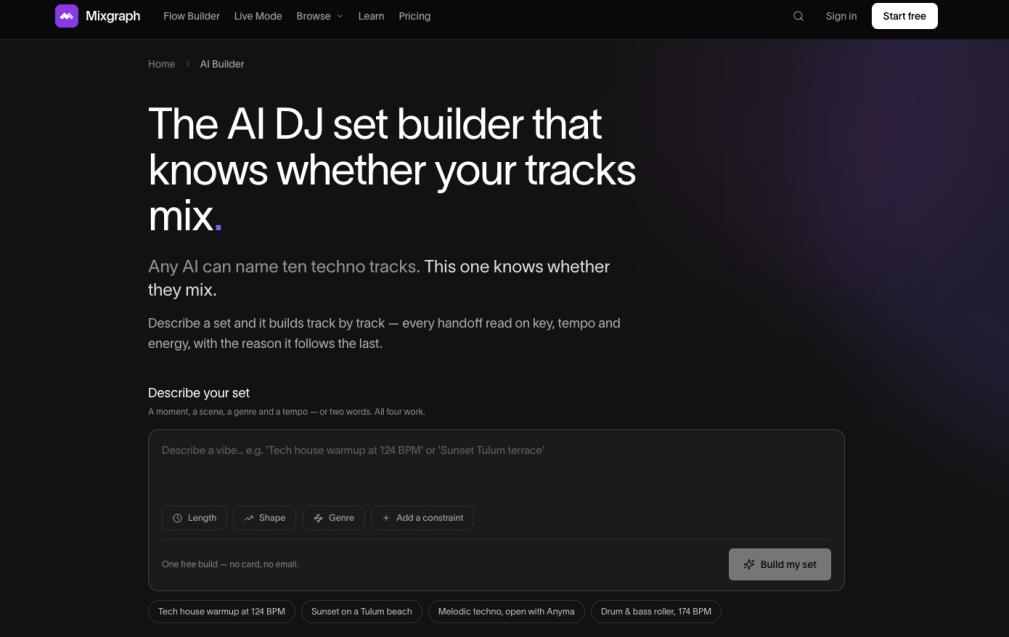
I fed that brief into Mixgraph, a natural-language set builder. It's the sort of tool that has become common in the last year: you type what you want in plain English and it hands back a tracklist matched on BPM, key, and energy.
Mixgraph goes a step further and gives every handoff a "chemistry" score, rated on harmony, tempo, energy, groove, mood and vocals. A two-hour set meant signing up for a free account, which stretches a build to about 24 tracks.
There's a catch worth knowing. Mixgraph picks from its own catalogue of more than 440,000 analysed tracks, not from my crates, unless you pay for Pro and import your library. I used a free account, so I had to source every track I didn't already own.
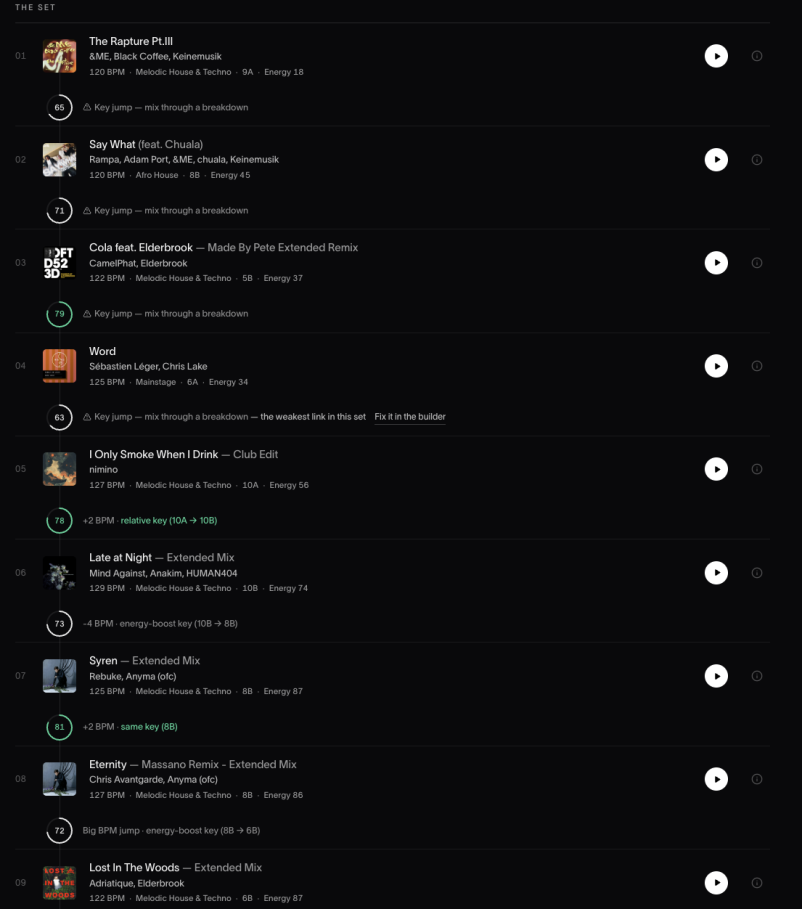
The first list came back fast. It was genre-accurate, tempo-accurate, and completely soulless. Every transition made technical sense and not one of them made emotional sense. It had clearly never stood in a room and watched what happens when a crowd needs eight more bars before the drop, instead of four.
This is an important point. These tools are built on the Camelot Wheel, the same key-matching logic that has underpinned harmonic mixing software for years, so the maths is sound. But music at 2 a.m. isn't maths. It's timing, mood, and reading 50 faces you've never met before. No amount of BPM-matching tells you that.
Building Versus Generating
Set building and mix generating turned out to be two completely different tests, and I ran them separately on purpose.
Building
For building, I tried three approaches:
A natural-language prompt tool (Mixgraph), building from its own catalogue.
A library-native planner that scored every possible transition against my existing collection. This was DJ.Studio, whose Harmonize feature (formerly known as Automix) reorders a pool of tracks imported from your own library by key and BPM.
My own ears, doing it the old way for comparison.
Both AI-sequenced versions were faster to produce by a wide margin. Both also flattened the set into something technically correct and dynamically dull, stacking similar-energy tracks back-to-back because the scoring models rewarded smooth transitions over interesting ones.
My own version had rougher key changes and took three times as long to build. But it had actual peaks and valleys in it.
Generating
For generating, I turned to DJ.Studio to create a handful of custom transition pieces: short instrumental beds designed to bridge two tracks that didn't naturally sit together. This is where things got more interesting.
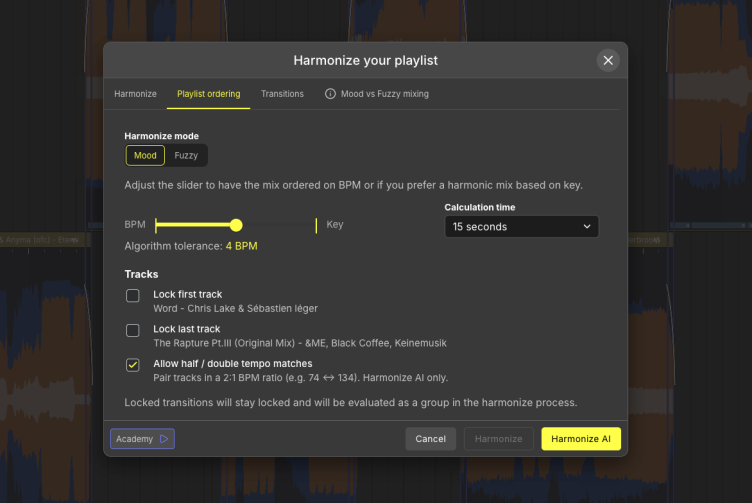
DJ.Studio also lets you edit mixes after it has automated them, but I didn't use that because it's against the rules of the experiment. No pulling the bassline down, no trimming the bridge, no fixing the one section that ran too long. You either accept what's generated, or roll the dice again. I therefore needed several attempts to create usable mixes. Prompting for a specific mood got me something close on the fourth or fifth try, never the first. Even then, there were obvious problems with overlapping instruments.
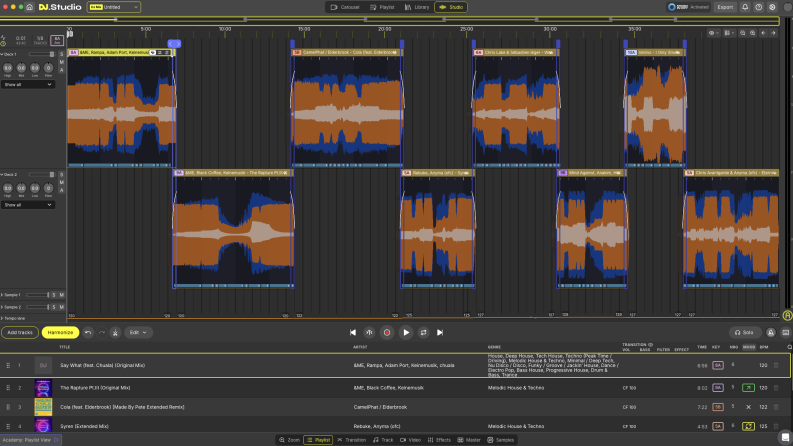
This is a genuinely different way of working from anything I've used before. Manual DJ software like Serato DJ gives you infinite small decisions. This gave me one option, repeated until something landed.
What held up in the mix wasn't the tracks with vocals. Instrumental, rhythm-forward material generated more reliably and mixed in more cleanly. AI vocal performance is the most inconsistent part of the current generation of tools, while instrumental and electronic-leaning output tends to be steadier.
Length was the other practical snag. These generation tools cap out at a few minutes per render, and extending a clip smoothly is clunky rather than seamless. For a DJ set, where you might want a 90-second bridge or a six-minute slow build, that ceiling matters more than it would for someone writing a standalone track.
The Bit Nobody Puts in the Demo Video
That generated transition bed raises a question the demo videos skip. Not every piece of AI-generated material, like the transition beds above, has a straightforward path to being recognised, credited, or paid out the way a conventionally released track does.
Start with recognition. In UK clubs, PRS for Music and PPL have used music recognition technology since their 2018 nightclub pilot to work out what DJs actually played. The leading system, DJMonitor, is built into Pioneer DJ kit and identifies 80 to 95 percent of what it hears. It works by fingerprinting the audio and matching it against a database of known recordings.
A transition bed I generated for this experiment isn't in that database. It was never released, registered or fingerprinted. As far as the reporting system is concerned, those minutes of my set are a blank. The same would be true of any unreleased, unregistered track, but AI-made material is the most likely to fall into that gap.
Then there's registration. In October 2025, ASCAP, BMI, and SOCAN started accepting "partially AI-generated" works, where a human wrote some of it. Works "entirely created" with AI tools are still not eligible. Korea's KOMCA made a similar move this summer, allowing AI-assisted works.
The law behind that line differs on each side of the Atlantic. In the US, copyright needs a human author. The Supreme Court declined to hear Thaler v. Perlmutter in March 2026, leaving that rule standing. The UK has protected "computer-generated works" under section 9(3) of the 1988 Copyright Act for decades, but the government's March 2026 report on copyright and AI said that provision could go.
Practically, that means the custom drop I generated for this experiment sits in a grey zone. It sounds fine on the night. What happens to it afterwards, in terms of recognition and credit, is a genuinely open question. I don't think DJs are asking it before they load AI-made material into a public set.
There's an irony in here too. The thing I complained about earlier, not being able to edit a generated clip, may be the same thing keeping it out of the rights system. The more a human shapes AI-generated material, the closer it gets to "partially AI-generated" and to something a society will register. One-click output stays a blank on the report.
The Room
On the test night I played a mixture of my AI-built DJ set and my own manual mixes, in one-hour blocks. Running the AI set start to finish wouldn't have been a fair test. The mood a room arrives in can make or break any set, and a dozen people on one evening can swing either way. Alternating gave both versions the same crowd, in the same mood, on the same night.
The difference showed in the shape of the night. The room stayed with the AI stretches, but it never really lifted. Every transition was smooth, and that was the problem: track after track sat at the same energy, and people settled into polite nodding rather than dancing.
It dipped in the longest AI-sequenced run, where similar-energy tracks stacked back-to-back with nothing to build towards. Nothing was wrong with any single mix, which is exactly why attention drifted.
The room perked up when I took over and pulled the energy down before pushing it back up. Those were the peaks and valleys the scoring models had smoothed away. Some of the AI-generated transition beds earned their place too. The instrumental, rhythm-forward ones slipped in cleanly enough that nobody noticed the join.
None of this makes the tools useless. It makes them a different kind of instrument. They're good for sketching an idea fast and for filling a specific structural gap. They're not yet good enough to hand over the whole creative decision and walk away.
So, Would I Do It Again?
Yes, but differently. The generation side earns its place as a sketchpad, something to reach for when I need a specific transitional idea fast and can live with rolling the dice a few times to get it.
The sequencing side earns a much smaller role. It's a decent starting point for a first draft and useful for spotting harmonic options I might have missed. But the final call on what goes where still needs a human who has actually stood in the room.
The honest headline isn't that AI built me a set. It's that AI built me half a set, and I built the half that mattered.
What I'm watching next is how quickly the editing gap closes. The moment these tools let you nudge a bassvline or trim a section without regenerating the whole clip, this stops being a novelty and starts being a real part of the workflow. I'll be tracking that shift closely, along with the wider questions around rights and recognition.