

To understand why V6 feels so different to many users, you have to remember how fast Suno got here.
Suno's v2 gave the public its first taste of AI songwriting in late 2023, raw in texture but loose in structure. V3, in March 2024, was the breakthrough, with real intros, build-ups and hooks, and it's what made Suno a household name. V4 (November 2024) tightened arrangements, and V4.5 (May 2025) added restraint and better pacing while becoming many users' experimental favorite.
V5 (September 2025) brought professional-sounding polish and Studio, Suno's generative audio workstation, though some found it too safe; V5.5 (March 2026) added crisper audio, Voices and Custom Models. Then V6 arrived on Sept. 9, 2026, and Suno retired every earlier model at once. That traces back to its November 2025 settlement with Warner Music Group, in which Suno committed to replacing its old models with licensed ones, and Suno says V6 was developed with Warner, BMG and Believe without the old training data.
A different training set changes what a model knows, and many users say they can no longer get the weird, experimental results they built their workflows around. If that's you, all is not lost, but V6 asks for a new way of working.
Think like a producer
V6 understands far more of the language musicians use, and in my experience that cuts both ways. It rewards precision, and vague labels like "lo-fi hip hop" don't get you very far anymore. The mindset that works for me is a dual role: you're directing the studio band and the recording engineer at the same time.
I personally build every style prompt in six layers (fitting, for V6):
Genre and subgenre, including tempo and time signature. This sets the rhythm and pulse, and you can still direct mashups and mid-song shifts. 90s East Coast boom bap, 128 BPM, 4/4 time.
Vocal performance. V6 handles tone, gender, accent and vocal character with much more precision, and duets are far more reliable. Gritty male raspy vocals, ethereal female soprano.
Instrumentation and performance. Name the instruments and how they're played, down to guitar model, amp, effects and tuning, and even the room. Staccato cello arpeggio, Gibson Les Paul in standard tuning, live club, small crowd.
Arrangement, energy and mood. Where the energy rises and falls, and the song's emotional color. Dynamic build-up, sudden drop, minimal orchestration.
Production and mix character. Tell a virtual mix engineer what "good audio" means to you. 1970s analog tape saturation, dry up-front vocal mix, lush hall reverb.
The tail trigger. What happens after the lyrics end. Sustained instrumental outro, long reverb tail, fading guitar echo.
Need it said differently? Here's a song explaining the six-layer model.
Here's a full six-layer prompt, all together:
90s East Coast boom bap, 128 BPM, 4/4 time, neo-classical, synthwave. Gritty male raspy vocals, ethereal female soprano, spoken-word cadence, autotuned trap delivery, gospel choir harmonies. Staccato cello arpeggio, overdriven electric guitar riff, heavy sidechained sub-bass, syncopated acoustic drum kit. Dynamic build-up, sudden drop, minimal orchestration, shifting arrangement arc. 1970s analog tape saturation, wide stereo field, dry up-front vocal mix, lush hall reverb, lo-fi vinyl crackle. Sustained instrumental outro, long reverb tail, sudden hard stop, fading guitar echo.
And here's the song it produced, "Late-Night Text":
Match the prompt to the model
V6 isn't one model. It's three: the flagship V6 and the experimental V6-wild for Pro and Premier subscribers, and the faster V6-mini, free for everyone. Each wants a different kind of prompt.
The flagship ("V6") behaves like a compliant studio engineer. It tries to map your six layers as literally as possible and delivers clean, radio-ready audio. Give it a generic prompt, though, and it can drift into a perfectly clean but slightly sterile sound. This is the model for finishing a track when you know what you want.
V6-wild behaves like an eccentric producer. It treats your prompt as a suggestion. Ask for rock and it might throw in a jazz bridge or a strange synth line because it found a texture it likes. In my experience, it gives more human, "alive" vocals and grittier analog textures. Feed it moods and imagery rather than specs, push the Weirdness slider up and reach for it when a track feels flat.
V6-mini is your sketchpad. It's lighter, so too many technical cues can muddy the mix. Cut the six layers down to the three or four that matter most, or skip the format entirely and describe the song in plain English in Simple mode. Test tricky lyrics and genre blends here, then carry what works over to V6 or V6-wild.
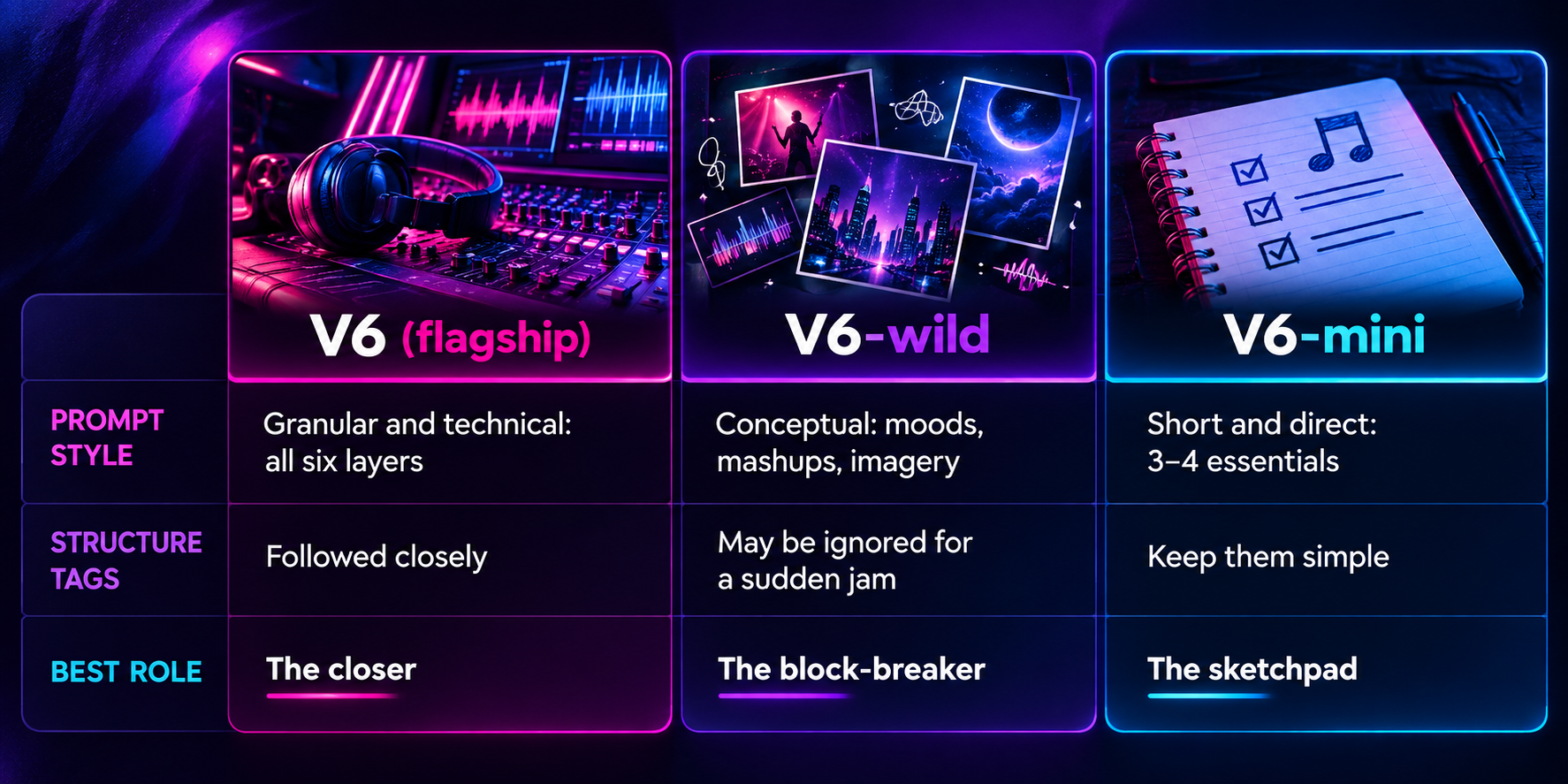
To see the difference, try 1970s bossa nova, smooth male vocals, lo-fi tape hiss. The flagship gives you a traditional bossa nova track with clean vocals and subtle hiss. V6-wild might turn "tape hiss" into dark, moody trip-hop with a bossa nova guitar loop underneath.
Use every control you have
The style prompt sets the sound, but the lyrics box controls each section. Bracketed tags let you switch genres or time signatures mid-song, trade lines between duet partners, add backup singers or set up call-and-response.
If all of this feels like a lot, get help. Full disclosure: I built a prompt tool designed for V6, promptAlizer [URL TK], with a song builder and prompt generator. You can also ask ChatGPT or Gemini to write prompts. Just tell it which V6 model you're using.
Putting it to the test
I remade two older songs in V6.
"Taking the Crescent From New Orleans" — V4.5 original, covered in V6
The V6 version sounds fuller, with livelier, more natural instruments and a wider, deeper stereo field. The V4.5 original sounds muffled by comparison, and its vocals are flat. I also remember the duet being tough to get right in V4.5, with a lot of tagging and re-running.
"Thank You, Jane" — V5 original, re-prompted from scratch in V6 with no audio to draw from
The original is very good, but the V6 version is on another level: more complex and spontaneous, like a jam, with substantially better sound quality.
The feature that isn't there yet
Custom Models, carried over from V5.5, let you upload songs from earlier versions so V6 can build from them. On paper, it's the perfect answer to "V6 ruined my sound." In practice, you have to upload MP3s, which spends your limited downloads, and Suno's copyright check kept rejecting my own songs for already existing. Isn't that the point? If Suno accepts song links and relaxes that check for users' own work, I'll try again.
Until then, V6 asks more of you than older models did. Give it precise direction, and in my experience, it pays off.