When the Recording Academy announced nominations for the 69th Grammy Awards on Monday morning, the headlines belonged to RAYE (11 nominations), Rosalía (nine), and Ella Langley (seven). But the nomination most entangled with AI sat further down the ballot, in Best Rap Album. There, Ye's Bully will compete with Busta Rhymes and J Dilla, Cardi B, Rapsody, Don Toliver, and Wale.
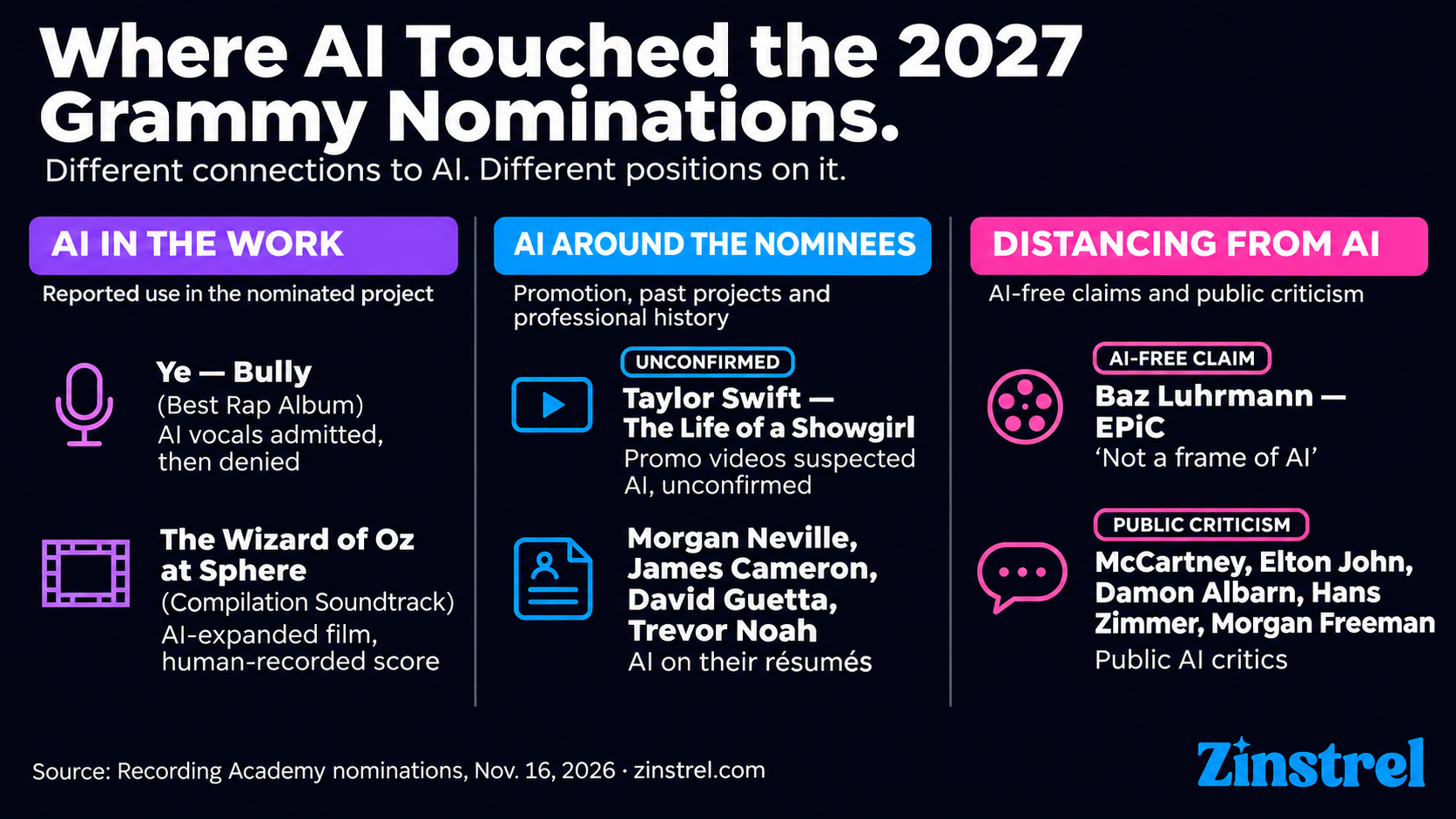
Bully is the only nominated album this year whose own creator has said it was made with generative AI. In a February 2025 interview with Justin LaBoy, Ye said the album would feature AI vocals. He released a short film, Bully V1, that openly used AI, and he said he used the technology "the same way I incorporated Auto-Tune," calling it "a tool, not a replacement."
Then he changed his story. On March 25, 2026, two days before the streaming release, he posted "BULLY ON THE WAY NO AI" on X. A vinyl rip leaked the same day, and fans flagged "Preacher Man" as still carrying AI vocals from an earlier version. In August, an anonymous producer sued Ye, claiming they were hired to create AI vocals for Vultures 2 and Bully and were never paid. Neither Ye nor the Academy has said which version of Bully went to voters.
That uncertainty is the clearest picture of AI at this year's Grammys. AI didn't get a category, and no AI-native act got a nomination. Yet it runs through the ballot anyway: in a rap album, a film soundtrack, a pop rollout, the résumés of nominated filmmakers and producers, and the protest records of some of the most decorated nominees.
The rule was built for this
The Academy settled its basic position on AI in 2023. Only human creators can be submitted, nominated, or win. A work with no human authorship isn't eligible in any category. AI-generated material is allowed as long as the human contribution is "meaningful and more than de minimis" (or, too small to matter) and fits the category in question.
Earlier this year, Recording Academy CEO Harvey Mason Jr. clarified the guidelines further. AI-generated material is permitted, but in songwriting categories, most of the song must be written by a human. Nobody can be nominated for the part the AI made.
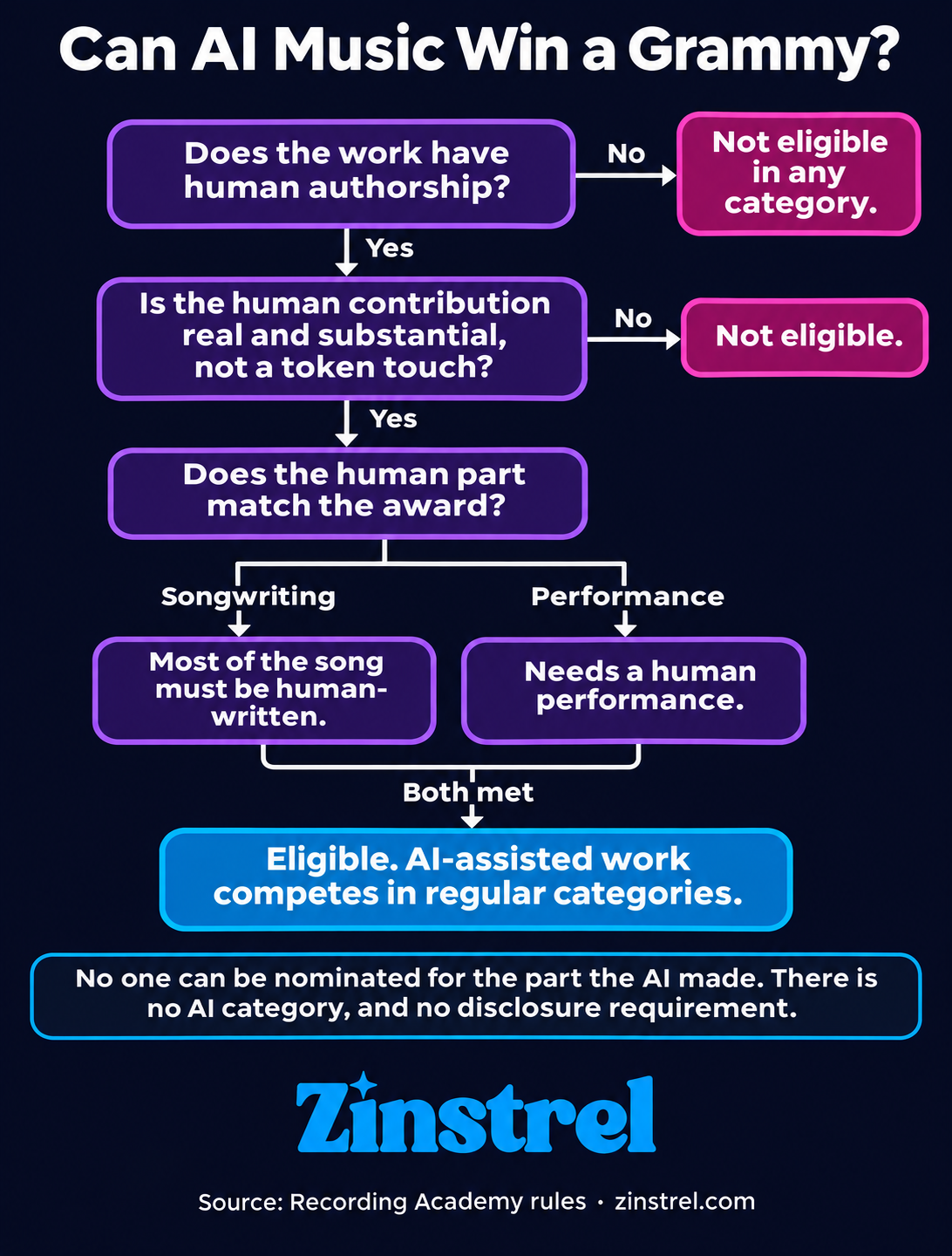
That's a tool-based rule, and Bully is what it looks like in practice. The Academy doesn't ask voters to sort out whose voice is whose. It asks whether a person made meaningful creative choices. That's a defensible line, and is close to how most working musicians already think about AI. But the rule has no disclosure requirement. When an artist says AI was used and then says it wasn't, nothing in the rulebook makes anyone settle the question before ballots go out.
AI around the work, not in it
The nomination with the most visible AI behind it is one most readers will skip past. The Wizard of Oz at Sphere is up for Best Compilation Soundtrack for Visual Media. Sphere Studios used generative AI to stretch the 1939 film across the Las Vegas venue's 160,000-square-foot screen, extending the scenery and placing characters inside larger scenes. Sphere President and COO Jen Koester said the technology was used to "pull shots together," but not to create new scenes or songs.
The nominated album is the human side of that project. An 80-piece orchestra re-recorded the full score on the original MGM scoring stage. To get there, the film's mono audio first had to be separated into stems of vocals, dialogue, and effects, a job Sphere and Warner Bros. describe only as "advanced audio technologies." So voters honored live musicians, on a project that exists because of AI.
Taylor Swift's The Life of a Showgirl, nominated for Album of the Year, has a looser connection. In October 2025, a Google scavenger hunt sent fans to 12 orange doors in 12 cities, where QR codes unlocked promo videos. Fans flagged the clips as AI-generated and rallied around #SwiftiesAgainstAI. Neither Swift's team nor Google has confirmed whether Veo 3 or any other generative tool was used. While the album itself isn't in question, its marketing is.
One nominee went out of his way to stay on the other side of the line. Baz Luhrmann's EPiC: Elvis Presley in Concert, up for Best Music Film, was restored at Peter Jackson's facilities in New Zealand, the same team behind Get Back. Luhrmann has been blunt about it:
"There's not a frame of AI in this film. There's not a visual effect." — Baz Luhrmann, director of EPiC: Elvis Presley in Concert
That a director now feels he has to say this in interviews is its own signal.
Nominees with AI on their résumés
The ballot also includes people who have already used AI, or helped build it, in ways that made news — although their Grammy-nominated projects this time around don't have AI included.
Morgan Neville directed and produced Man on the Run, the Paul McCartney documentary nominated for Best Music Film, and he shares McCartney's nomination for Best Audio Book, Narration, and Storytelling Recording. In 2021, Neville fed more than ten hours of Anthony Bourdain's recorded voice into an AI model for Roadrunner, so Bourdain could "read" three lines he had written but never said aloud. Neville said he had permission. Bourdain's widow, Ottavia Busia-Bourdain, disputed it:
"I certainly was NOT the one who said Tony would have been cool with that." — Ottavia Busia-Bourdain, widow and estate executor of Anthony Bourdain
James Cameron co-directed Billie Eilish's Hit Me Hard and Soft: The Tour Live, another Best Music Film nominee. In September 2024, Cameron joined the board of Stability AI, the company behind Stable Diffusion, calling the meeting of generative AI and CGI "the next wave."
David Guetta is nominated for Best Remixed Recording for his remix of RAYE's "Where Is My Husband!" with Hypaton. In February 2023, he played a crowd a track with an AI-cloned Eminem verse he called "Emin-AI-em," using one AI tool to write the lyrics and another to clone the voice. He promised not to release it commercially, and explained how it happened:
"There's something that I made as a joke and it worked so good. I could not believe it." — David Guetta, DJ and producer
Even the comedy field has a link. Trevor Noah, nominated for Best Comedy Album for Joy in the Trenches, holds the title of Chief Questions Officer at Microsoft, where he hosts The Prompt, a video series on AI projects.
And the nominees pushing back
The ballot also reads like a roll call of the artists fighting AI training rules. McCartney, nominated for Best Traditional Pop Vocal Album for The Boys of Dungeon Lane, and Elton John, nominated for Best Immersive Audio Album for the 50th-anniversary Captain Fantastic and the Brown Dirt Cowboy, both publicly criticized the UK government's 2025 plan to let AI companies train on copyrighted work. That's a more complicated position for McCartney than it looks. The Beatles' "Now and Then," finished from a John Lennon demo with machine learning, earned the band a Grammy nomination as an AI-assisted work with human creators at its center.
Damon Albarn, whose Gorillaz album The Mountain is up for Best Alternative Music Album, and Hans Zimmer, featured on RAYE's "Click Clack Symphony" (nominated in three categories), were both among the 1,000-plus artists on Is This What We Want? That silent protest album was organized by composer Ed Newton-Rex, and its 12 track titles spell out "The British Government Must Not Legalise Music Theft To Benefit AI Companies."
Morgan Freeman, nominated for Best Traditional Blues Album for Morgan Freeman's Symphonic Blues Experience, has spent the past year going after AI clones of his voice. He told The Guardian in November 2025:
"I get paid for doing stuff like that, so if you're gonna do it without me, you're robbing me." — Morgan Freeman, actor and narrator
Then there's Angine de Poitrine, the masked Québécois math-rock duo with four nominations, including Best New Artist. Their year has been told almost entirely as an anti-AI story. Ticketmaster's editorial site called their rise "a rebuke to AI slop," and one concertgoer reportedly screamed "Death to AI!" at a show. It's an absurdist equal and opposite reaction to AI.
What's not on the ballot
What's missing is any act built mainly on AI. The same weekend the Grammy nominations came out, SIQA held its first AI Music Awards. Xania Monet, the AI persona of Telisha "Nikki" Jones, won AI Album of the Year and went on to take artist and song of the year. Under the Academy's rules, a Suno-generated performance can't earn a performance nomination, so the year's most commercially successful AI artist was never really in the running.
One nominee has asked for a different arrangement. Chronixx, whose Exile is up for Best Reggae Album, posted on Instagram on his birthday, October 10:
"LLM and machine learning albums should be in a separate category." — Chronixx, reggae artist and Best Reggae Album nominee
Exile itself is credited to human musicians and technicians. Chronixx didn't name the Grammys or say where he'd draw the line, which is exactly the problem.
Complex's nominations roundup said that apart from Bully, there didn't seem to be much tension around AI this year. I'd put it differently. The tension is there; it just isn't labeled. AI can now help get a classic film onto a giant screen, feed a rollout, sit in a nominated filmmaker's past work, and possibly sit on a nominated rap album, all without changing anyone's eligibility.
Whichever path the Academy takes, it needs to be specific. "Meaningful" human contribution was a reasonable starting point in 2023. By 2027, with voice models, AI-expanded films, and AI-native artists topping charts, voters deserve to know what they're judging.
The Grammys didn't nominate AI this year. They also didn't really ask about it, and that won't hold for long.